Showing posts with label Mercedez-Benz. Show all posts

Monday, August 1, 2011

2012 Mercedes-Benz M-class - First Drive Review


2012 Mercedes-Benz M-class / ML350 4MATIC / ML350 BlueTec
Before the recession, Mercedes-Benz had no trouble selling 34,000 MLs in the U.S. each year. For 2011, the company’s best-known SUV is back on track to hit 30,000 sales. Right now, in fact, ML sales are up 14.5 percent. “It puts us in a funny position,” confesses Mercedes U.S.A. president and CEO Ernst Lieb. “We’re spending millions to replace a car that remains a huge profit center.” It’s like replacing Yankee Stadium’s hot dogs with, say, toaster waffles. Are you sure you want to mess with a good thing?
That’s nonetheless what Mercedes is doing with its third-gen M-class, which, we hasten to add, resembles wieners and waffles only in its ability to cause customers to queue up. The first to arrive is the ML350 4MATIC, powered by a new, direct-injection 3.5-liter gas V-6 producing 302 horsepower (an increase of 34). It will be partnered with the ML350 BlueTec 4MATIC, motivated by a redesigned 3.0-liter V-6 turbo-diesel making 240 horsepower (an increase of 30). Base price for the gas ML is $49,865, and the diesel, now accounting for 13 percent of sales, fetches an additional $1500.
This new ML is about an inch longer and a half-inch wider, and it squats 0.8-inch lower than before. Cargo capacity behind the rear seat has grown seven cubic feet.
The baseball bat of a turn-signal/wiper stalk thankfully has been moved to the 10-o’clock position on the steering column, and its cruise-control function has been relegated to a second stalk at 8 o’clock. Unfortunately, you’ll still find yourself flicking at the column-mounted gear selector whenever you desire wipers. It’s annoying.


On road, we drove a gas-powered ML350 with the Dynamic Handling package. That $5150 option includes the Active Curve System (ACS), which decouples the anti-roll bars both off-road and during straight-ahead freeway slogs. We never felt it coupling or decoupling. We never felt it doing much of anything, to tell the truth, although body motions were satisfactorily controlled in the hills. But body motions were also satisfactorily controlled in a non-ACS ML we sampled, and that one didn’t max out at a cosmically startling $73,055. As the ML negotiates turns, you can still feel huge lateral load transfers, and the seats’ weak bolsters further suggest that this SUV might possess grand ambitions, but handling is not among them.
We’ll tell you one thing: This new ML is spectacularly quiet, subjectively as quiet as, say, a Lexus LX570, thanks to high-insulation glazing and additional sealing. And the ML pretty much matches the Lexus’s memorably cushy ride, too. Suspension travel feels endless; road nastiness is filtered to a fine fare-thee-well. Unfortunately, highway textures and slip angles are likewise filtered out of the light steering, as if such information might be an affront to the driver. The brake pedal isn’t doing much talking, either. At least interstate tracking is flawless.
The seven-speed transmission’s upshifts and kickdowns are supremely gentle, and engine roar is reduced to a velvety hum seemingly emanating from an adjacent ZIP Code. Fit and finish are of a quality that should make assembly workers in storm-smacked Tuscaloosa County, Alabama, proud. For two riders, back-seat legroom is excellent, kneeroom superb, headroom vast.


We nosed an ML350 BlueTec diesel off-road, through sippy holes, bogs, and ugly ruts. Over hill and dirty dale, the long-travel suspension, the silky dampers, and the rock-solid platform conspire to improve the experience. You’ll find that the road-biased M+S rubber, however, is not your ally in the mud. The diesel engine definitely is an ally—it’s among the most velvety oil-burners ever installed in a passenger car. No clatter, no soot, no odor, no tactile evidence to reveal its baser origins. The driver notices only a slightly delayed throttle response, an added half-second of laziness at step-off.
Eight-cylinder MLs will arrive in the first quarter of 2012. Two-wheel-drive models will follow, as will a more off-road-biased version with a terrain selector and a two-speed transfer case.
Mercedes says the new ML is only a few pounds heavier than its forebear, but the vehicle feels massive, a little slow-witted, and somewhat resistant to course corrections. If you’re looking for driving gratification or personality, well, it will have to derive from the M-class’s luxurious fittings and from its soothing soundlessness. Ten minutes after climbing out, you’ll remember the awesome stereo more than any dynamic merits. Sometimes progress smells like waffles.


Specifications

VEHICLE TYPE: front-engine, 4-wheel-drive, 5-passenger, 5-door wagon

BASE PRICE: $49,865–$51,365

ENGINE TYPE: turbocharged and intercooled DOHC 24-valve 3.0-liter diesel V-6, 240 hp, 455 lb-ft; DOHC 24-valve 3.5-liter V-6, 302 hp, 273 lb-ft

TRANSMISSION: 7-speed automatic with manual shifting mode

DIMENSIONS:
Wheelbase: 114.8 in Length: 189.1 in
Width: 75.8 in Height: 70.7 in
Curb weight: 4900–5150 lb

PERFORMANCE (C/D EST):
Zero to 60 mph: 6.9–7.8 sec
Standing ¼-mile: 15.2–15.8 sec
Top speed: 130 mph
PROJECTED FUEL ECONOMY (MFR'S EST):
EPA city/highway: 17–20/22–25 mpg
source : Caranddriver.com

Friday, July 29, 2011

Fastest Cars In The World: Top 10 List 2011-2012

World's Fastest Cars

While most of us can only dream of owning the fastest car in the world, some will do whatever it takes to possess the most powerful speed. So, how fast are the fastest cars in the world? Here are the 10 fastest cars available on the market (production models, as opposed to concept cars) measured by tested top speed (theoretical speeds do not count).

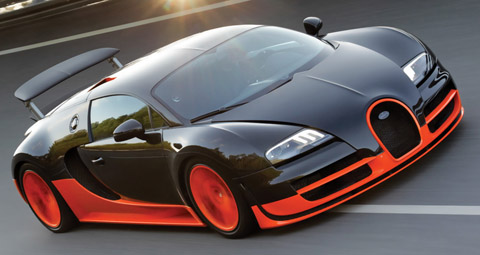
1. Bugatti Veyron: 267 mph, 0-60 in 2.5 secs. Aluminum, Narrow Angle 8 Liter W16 Engine with 1200 hp, base price is $1,700,000. The Super Sport version is $2,400,000. The speed was tested again on July 10, 2010 with the new 2010 Super Sport Version: the Bugatti Veyron once again claims the title of the fastest car in the world at 267 mph.

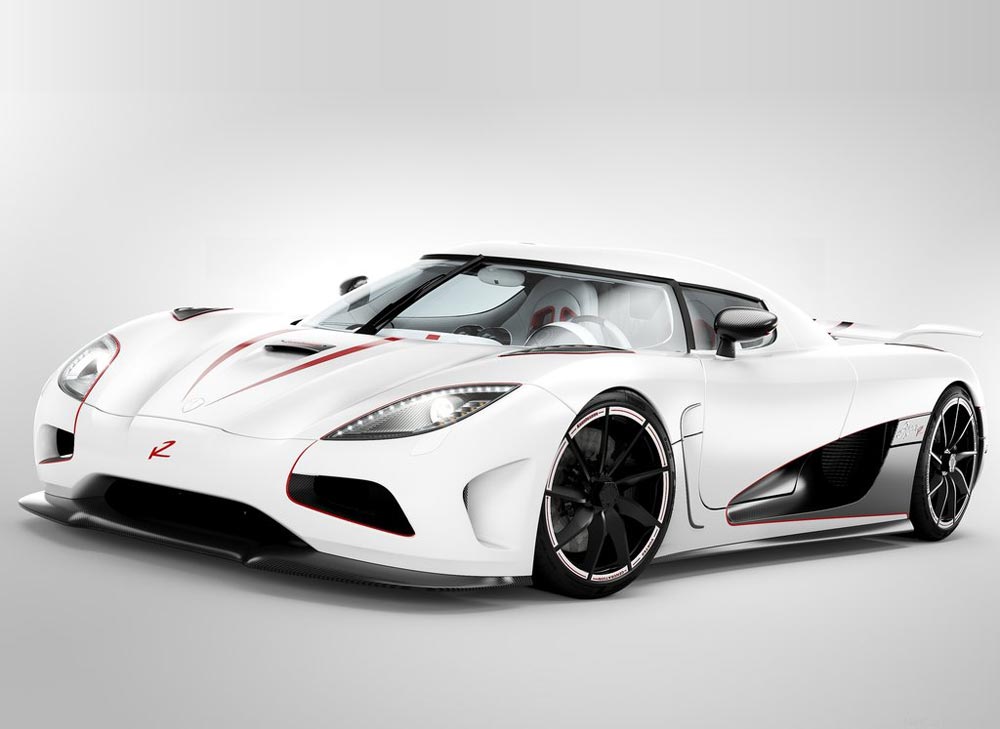
2. Koenigsegg Agera R: 260 mph, 0-60 in 2.8 secs. 5.0-liter V8 Engine with twin turbo’s, housing 1099 hp. Base price is $1,600,000. If you're into snow sports, the Agera R can be fitted with a Ski Box as well as winter tires, not that I would take one on a ski trip or anything like that. While the Agera R has a massive theoretical top speed, the current tested top speed is 260 mph. Expect this snow car to be the Bugatti's arch enemy for the next 5 years.
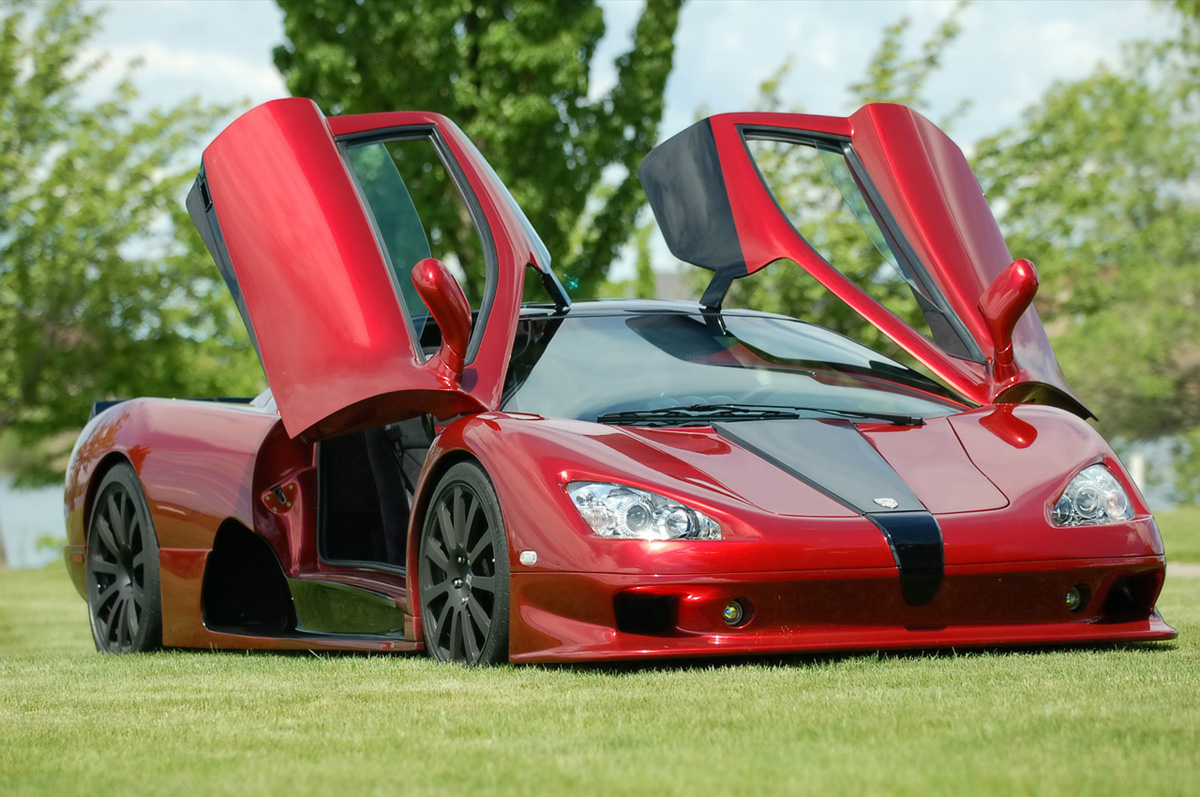
3. SSC Ultimate Aero: 257 mph, 0-60 in 2.7 secs. Twin-Turbo V8 Engine with 1183 hp, base price is $654,400. Tested in March 2007 by Guinness World Records, The SSC Ultimate Aero was the fastest car in the world from March 2007 to July 2010. On March 2011, the Koenigsegg Agera R also surpassed it, forcing this American made car to the #3 spot.
SSC Ultimate Aero Red doors open
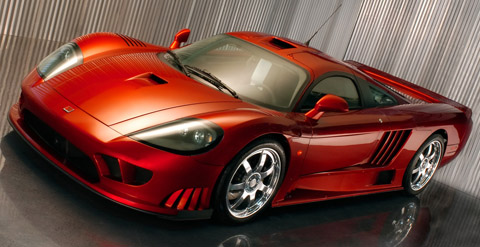
4. Saleen S7 Twin-Turbo: 248 mph, 0-60 in 3.2 secs. Twin Turbo All Aluminum V8 Engine with 750 hp, base price is $555,000. Smooth and bad-ass. It will make you want to show it off non-stop.
Saleen S7 Twin Turbo dark orange front view
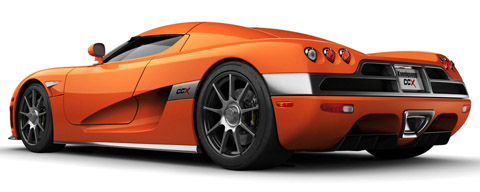
5. Koenigsegg CCX: 245 mph, 0-60 in 3.2 secs. 90 Degree V8 Engine 806 hp, base price is $545,568. Made in Sweden, it is the older brother of the Agera R, only losing to 4 other supercars in the world.
Orange Koenigsegg CCX
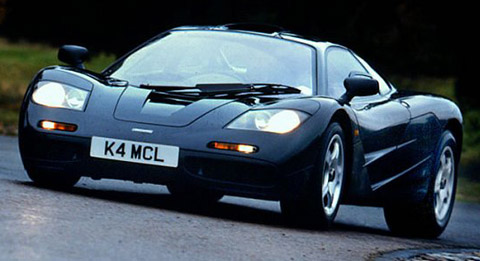
6. McLaren F1: 240 mph, 0-60 in 3.2 secs. BMW S70/2 60 Degree V12 Engine with 627 hp, base price is $970,000. The fastest car in the 20th century with doors that looks like bat wings. Maybe Batman needs to order one and paint it black 1997 McLaren F1 on the road black
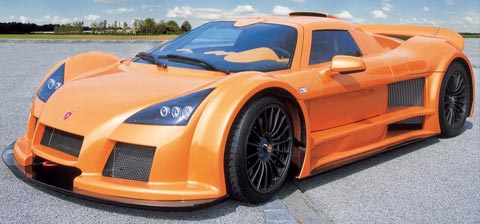
7. Gumpert Apollo: 224 mph, 0-60 in 3.0 secs, 4.2 liter V8 Engine that houses 650 hp. Base price: $450,000. Gumpert claims that the Apollo was designed such that it could drive upside-down in a tunnel with speeds at 190 mph or above. Of course, no one has tested this yet.
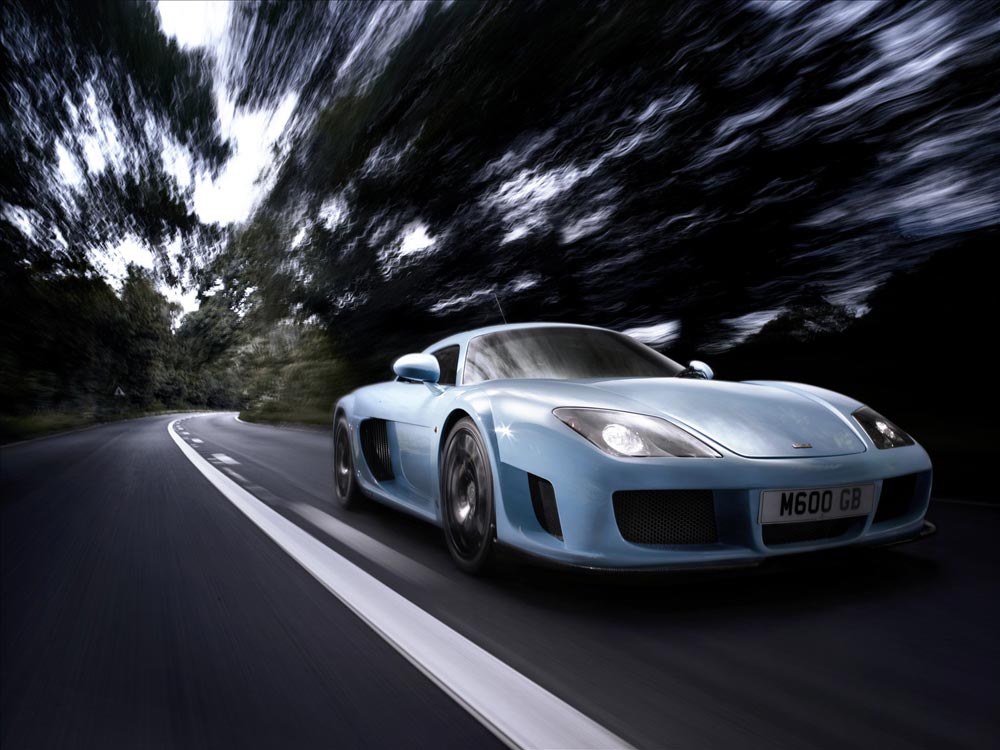
8. Noble M600: 223 mph, 0-60 in 3.7 secs. Twin-turbocharged 4.4-liter V8 Engine with 650 hp. Base price is $330,000. The Noble M600 also happens to be a very cool car. Its inconspicuous design sports a slender and contoured body which does not scream out for attention at every second of the day.
We have a tie for 9th and 10th places:
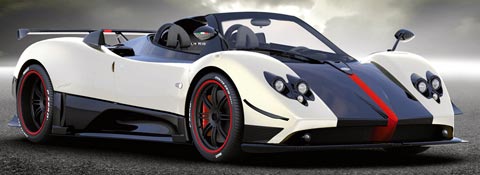
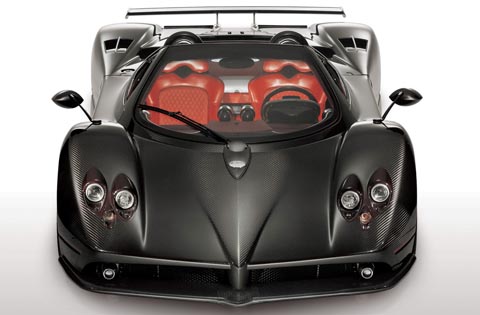
9. Pagani Zonda Cinque Roadster: 217 mph, 0-60 in 3.4 secs. Twin turbocharged AMG V12 engine that produces 678 hp. Base price is $1,850,000. The Pagani Zonda Cinque Roadster is a limited-edition, with five ever produced. It is the quintessential exotic and exclusive supercar.
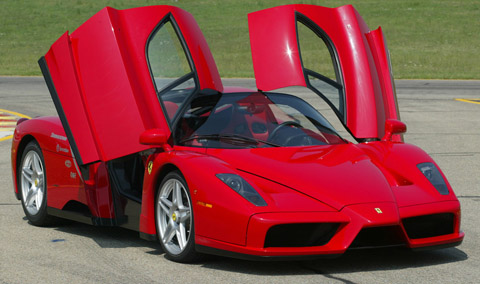
9. Ferrari Enzo: 217 mph, 0-60 in 3.4 secs. F140 Aluminum V12 Engine with 660 hp, base price is $670,000. Only 399 were ever produced; the price goes up every time someone crashes.Ferrari Enzo doors open front view
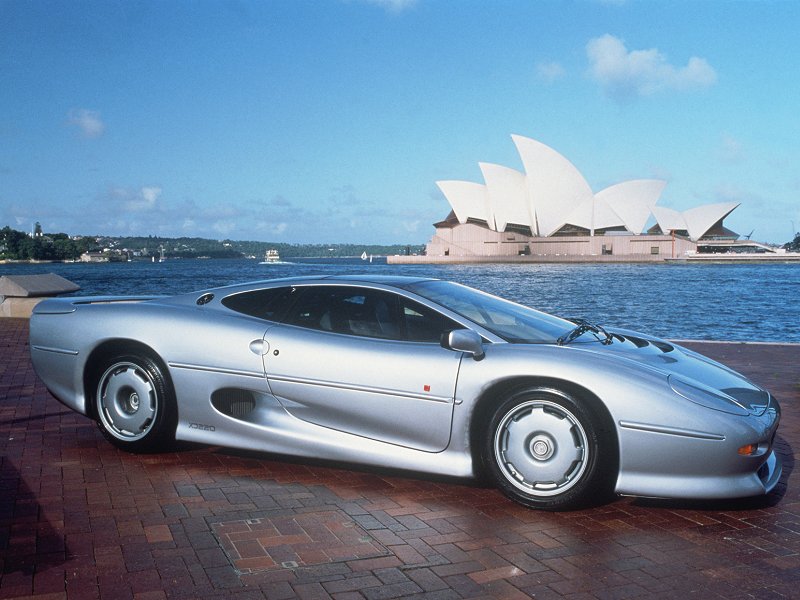
9. Jaguar XJ220: 217 mph, 0-60 in 3.8 secs. Twin Turbo V6 Engine with 542 hp, base price was $650,000. Made in 1992, this car still has what it takes to make the list.
Jaguar XJ220
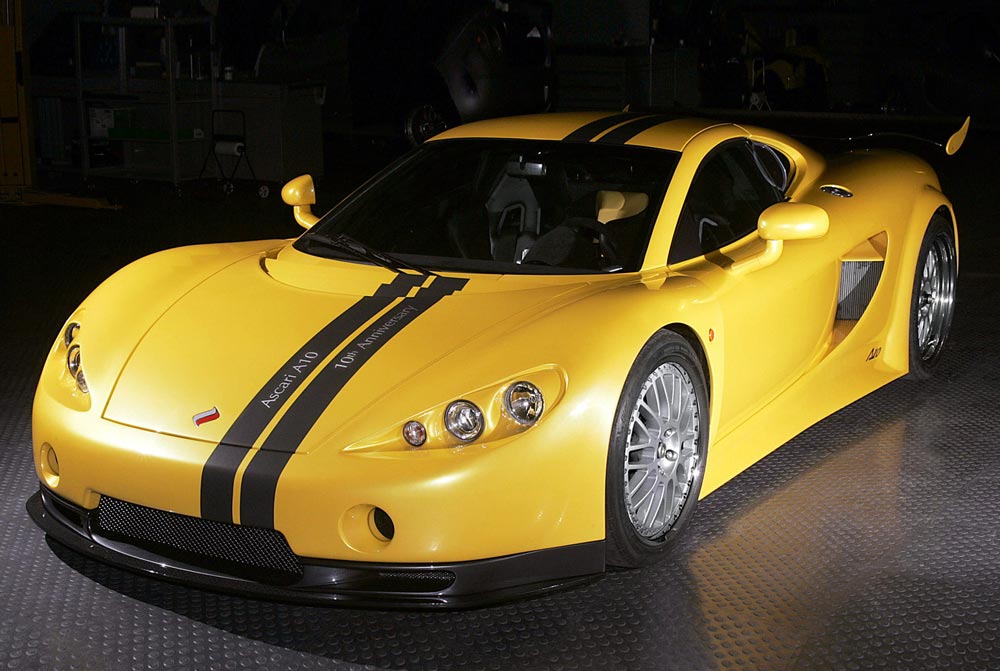
10. Ascari A10: 215 mph, 0-60 in 2.8 secs. 5.0 litre BMW V8 S62 Engine with 625 hp. Base price: $650,000. The company planned to produce 50 of these supercars at its factory in Banbury, England.
10. Pagani Zonda F: 215 mph, 0-60 in 3.5 secs. Mercedes Benz M180 V12 Engine with 650 hp, base price is $667,321. With a V12 motor, this baby can do much better.

pagani zonda f
Source : thesupercars.org

Saturday, July 23, 2011

2012 Mercedes-Benz C63 AMG Coupe Black Series

2012 Mercedes-Benz C63 AMG Coupe Black Series

The latest in a very short but highly distinguished—and completely nuts—line of Black Series Benzes is here. The C63 AMG Black Series is based on the C63 coupe, which we just drove for the first time a few months ago. Following the lead of the not-for-U.S.-sale SLK55 Black Series, the CLK63 Black Series, and the SL65 Black Series, this C63 AMG is amped up visually and dynamically, with a steroidal bump in output to back up the flared nostrils.
In case the 451 hp and 443 lb-ft in the standard-issue C63 AMG or the 481 and 443 offered by that car’s AMG Development Package aren’t quite cutting it, the C63 AMG BS makes 510 hp at 6800 rpm and 457 lb-ft at 5200. Like cars with the Development Pack, the Black Series borrows its pistons, connecting rods, and crankshaft from the be-gullwinged SLS AMG supercar. Behind the motor lives the same seven-speed automatic found in the regular C63, packing four shift modes and a launch-control function for when you really don’t want to linger at this stupid party one more split second. We ran a Development Pack sedan to 60 mph in just 3.9 seconds; with wider rear rubber, figure on the Black Series shaving a couple tenths from that and clearing the quarter-mile in around 12 seconds flat.


I’m Going to Eat You
Like the Black Series cars that came before it, the C63 oozes menace and purpose. Air can’t flow through stuff, so there’s remarkably little material remaining in the front fascia, the bumper that once resided there largely displaced by intakes covered by black mesh. A gaping central intake is flanked by two smaller holes through which cooling air enters, and two nostrils atop the hood give hot air a convenient exit from underhood. As if to emphasize its name and purpose, the front splitter comes to a sharp point in the middle of the nose.
Flared fenders widen the car by 2.2 inches up front and 3.3 out back, covering tracks stretched by 1.6 and 3.1 inches, respectively. Vents behind the front wheels and ahead of the rears are both nonfunctional, which somewhat diminishes their awesomeness. The lightweight wheels at each corner have their movements controlled by adjustable coil-overs, while speed-sensitive steering issues directional orders and Black Series–specific anti-roll bars maintain the contact patches during aggressive driving. The brake rotors measure 15.4 inches in diameter up front and 14.2 inches out back. Red paint is standard on the calipers, which have six pistons up front and four in the rear. The rubber measures 255/35-19 up front and 285/30-19 out back—that’s up from 235/40-18s and 255/35-18s on the basic C63 AMG coupe—and a limited-slip diff is standard, as is a stability-control system that will get entirely out of the way if you want it to.


Flat Bottom Girls
You’ll notice hard-shell sport buckets in the accompanying photos, but those aren’t likely to make it to the U.S. We are likely, however, to at least get red stitching on whatever seats we do end up with. Calm down. The rear seat has been dismissed in the interest of weight savings, but can be reactivated if you’d like to frighten more than just one person at a time. And AMG has flattened both the bottom and top of the steering wheel, which makes it way more serious than all those wheels with just flat bottoms. Lest the screaming V-8 deafen your passenger to the point they can no longer hear the V-8 screaming, a Black Series logo on the dash will remind them why they can’t hear.
Those who feel the flared and vented look of the C63 AMG Black Series isn’t quite enough will be able to crank up the appearance even more with an AMG Aerodynamics package that includes carbon-fiber winglets on the front valance and a fixed carbon-fiber spoiler with an adjustable aerofoil. AMG says these bits are functional and increase downforce, but isn’t saying by how much. It also won’t provide photos of a car so equipped, so we don’t know by how much they make it look more menacing and/or ridiculous. The C63 Black’s other major option package is a Track pack that includes even higher-performance rubber of unspecified Dunlop pedigree, as well as a differential cooler.
All Black Series cars to this point have been low-production affairs, the SLK55 AMG, for example, being limited to just 120 units. The CLK63 and SL65 sold in slightly higher numbers, at 700 and 350, respectively. While Mercedes isn’t saying yet how many C63 AMG Black Series it will build, representatives do tell us the number will be capped. Figure on a sticker edging close to $100,000. While that’s awfully steep for a car that shares its basic shape and structure with a coupe starting in the mid-$30,000 range, it is about $40,000 cheaper than the CLK63 Black Series and a whopping $200K less than the SL65 Black Series. So if you’ve got a spot reserved in your garage for what will certainly be the cheapest U.S.-market Black Series car yet, get on the horn to your dealer now. U.S. distribution will begin early in 2012.
 
Source : Caranddriver.com

Thursday, July 14, 2011

Grosser Gravy: 10 Things You Didn’t Know About the Mercedes-Benz 600


In our August issue, we took a short look at the life of Karl Middelhauve, the Wisconsin man who makes his living restoring Mercedes-Benz’s 600 Grosser limousine. In addition to being a world-renowned authority on one of the most fascinating cars ever built, he’s a fantastic storyteller. When we put the print issue to bed, there was a lot of great stuff on the cutting-room floor. Now it’s time to share.
Background for those who just came in: The 1963–1981 Mercedes-Benz 600 is the only cost-no-object production Mercedes ever built; MSRP when new was around $20,000, but current values start at three or four times that. Routine maintenance can cost as much as a new Toyota Corolla, and a full restoration generally runs well into six (or even seven) figures. It’s complicated, artful, and glorious.
Here, a deeper look at the 600’s special brand of genius. Enjoy.

1. It was purchased by a bunch of dictatorial sociopaths who didn’t mind killing other people. And Jack Nicholson.


Because for many years the 600 was the most luxurious and obnoxiously refined vehicle on the planet, the rich and famous swarmed to it. Most everyone knows this. Everyone knows, too, that der Grosser was a favorite of heads of state—the 600’s massive, imposing bodywork says nothing so much as I Am Coming to Rule Your Face, Peons, and I Will Drive Over Your Brain if You Don’t Agree.
What isn’t widely known is the extent of the car’s ownership roster. On a 2009 episode of the British television show Top Gear, co-host James May rattled off the following list of confirmed 600 owners: Leonid Brezhnev, Fidel Castro, Nicolae Ceauşescu, Idi Amin Dada, Enver Hoxha, Hirohito, Saddam Hussein, Mao Tse Tung, and Marshal Josip Broz Tito. Other owners reportedly included Irish leader Éamon de Valera, Iranian Shah Mohammad Reza Pahlavi, Korean dingbats Kim Il-sung and Kim Jong-il, Ferdinand Marcos, Deng Xiaoping, and Cambodian king Norodom Sihanouk. Time magazine says King Hussein of Jordan ordered one when new, as did Archbishop Makarios III of Cyprus and Indonesian president Suharto.
But wait! There’s more! Confirmed celebrity owners include Elvis Presley, George Harrison, John Lennon, Hugh Hefner, Jamiroquai’s Jay Kay (he bought Coco Chanel’s old car), and Jack Nicholson, who purchased his after driving it in The Witches of Eastwick. Harrison even bought Lennon’s old car when the latter moved to the United States from Britain, so he had two. Fancy, eh?


2. The 600’s legendary hydraulic system, which powers everything from the reclining rear seats to the sunroof, is remarkably complex and can be frighteningly durable if you don’t make a simple mistake and kill it.


The 600’s specially designed, engine-driven hydraulic system controls the windows, the front and rear power seats, the fresh-air ventilation system, door closure, trunk closure, the sunroof, and suspension damping. It runs on mineral oil and operates at a nominal 3200 psi. It was dreamed up as a way to provide the car with absolutely silent accessory operation, and it is, in a word, amazing.
Middelhauve on the system’s durability:
“The problem is, once you have a small leak in the system, you go to [an inexperienced] mechanic, he looks at it, it’s red fluid, so he pours in transmission fluid. But the oil in the 600’s system is mineral-based, not synthetic. If you consistently refill it with transmission fluid, it eats up the rubber seals. It takes about two years or so, and then the car is like a sieve. Fluid fills the doors and seeps out of the bottoms.
“The other thing is, the wrong fluid also affects pump performance. And when you have a wear factor in the pump pushing 3200 psi against a dead [suspension] air cylinder, the pressure can swing to twice that or more. That ultimately ruins the pump. The cylinder has a piston with nitrogen on one end at about 1000 psi, and if the gas cushion wears down, then the pump only will operate the car when it’s running. All this takes years, though. If you service the system right with the right fluid, it’s not that bad.”
No, of course not. Sounds simple enough, right?
There’s also this: “If a line breaks, the stream of hydraulic fluid can go right into your finger. It’s just like a knife.”
Good to know.


3. A window can take your arm off. The window switch, which makes it possible to take your arm off, costs $11,200.


The 600’s windows are operated by a variable-rate switch—essentially a pressure-sensitive valve body that lives in the door and routes fluid to the window regulators.
When lowering the window, this switch acts in a simple on-off fashion; push it, the window moves at one speed. When raising the window, however, the switch offers a variable rate—pressing it gently creeps the glass up, but nailing it slams the window shut fast enough to slice off a body part. You can hear it whunk into the door. It sounds like a cleaver pounding into a chopping block.
For some ungodly reason, this switch, which also operates all four windows from the driver’s side, currently retails for $11,200 from Mercedes-Benz. Fortunately, it can be repaired for a more reasonable price. The suspension-height switch—the cockpit valve that adjusts the 600’s ride height—goes for a more manageable $1400.
And you thought your old S-class hoopty was a money hole.

4. You can break the trunk hinges with your bare hands.


Like virtually everything else here, the 600’s trunk open/close mechanism is powered by 3200 psi of pressurized oil. Pull the lever beneath the lid, the trunk pops open. Push it—without touching the lid, natch—the trunk closes. Quickly. Attempt to push the lid closed with your hands and you can bend the trunk hinges.
Yes, that’s right: This car is so fancy you can break the trunk by trying to close it yourself. But really, who expects to close a lid with their hands, anyway? (“Rich people do not touch things, dahling. We have people and buttons for that.”)

5. Its designer, Paul Bracq, wasn’t a one-hit wonder.


Here we have a man with one hell of a résumé: In 1953, Paul Bracq, the 600’s designer, graduated from the École Boulle, the famous art and design school in Paris. In 1957, after a short stint in the military, he became chief of Mercedes-Benz’s advanced design studio in Sindelfingen. He’s credited with the 1960s “Pagoda” SL and the W108/109, W111, and W114/115 sedans. After leaving the company in 1967, he did consultant work and helped design France’s high-speed TGV passenger train.
It doesn’t stop there. Bracq was chief of BMW design from 1970 to 1974. He’s responsible for the shape and detail of the E12 5-series, the 2002 Turbo, the E21 3-series, the E24 6-series, and the E23 7-series. He also penned the two 1970s BMW Turbo concept cars, the functional design studies that presaged Munich’s M1 supercar. Shortly after leaving BMW, he landed at Peugeot, where he designed interiors for more than two decades. He now lives in France, where he devotes his time to his career as a world-renowned painter.
Did we mention how we’ve done nothing with our lives?

6. Its front suspension is shared with no other Mercedes model of the period.

The 600’s independent front suspension can be summed up in two words: ball joints. Where lesser Mercedes-Benzes used a service-intensive and wear-prone kingpin setup, the Grosser featured front uprights located by ball joints. This was a technically progressive move for the time—remember, the 600 came out in 1963—and from a company not known for rapid adoption of engineering advancements. No other Mercedes of the era was so equipped.


7. History has seen stiffer, heavier, and more ridiculous private limousines. But this one was built out of industrial-grade, bunker-busting German bluster. Fittingly, it’s all but indestructible.


Middelhauve on the 600’s construction: “Because of the mass and the construction of the car, the [600’s] plain chassis was stiffer than an entire [W112, 1961–1967] 300 sedan. You jack a wheel up at the front, the rear wheel goes off the ground, too. It’s so stiff, so stable. As for the rest, the steel that’s in there—I haven’t seen a 600 where the rockers are rusted through. It just doesn’t happen.”
Every piece of 600 trim, both interior and exterior, is handmade or hand-finished. Everything is custom-fit to each individual car—the brightwork, for example, was all produced, ground to fit, and then sent off to be plated.
Note: The 600’s three-pointed-star hood ornament is roughly 20 percent bigger than the hood ornament fitted to other Mercedes-Benzes of the same era. Same for the trunk badges. Blame the car’s massive scale, the importance of proportion in good design, and a bunch of absurdly anal-retentive Germans. God bless ’em.

8. The twin-tone horn is loud enough to relaunch the Titanic.


Two horns. One rocker switch on the dash, just above the steering column. One side of the switch is blank; the other features a pictogram that looks like a flugelhorn or something.
Tap the switch one way, you get a normal car horn. Tap it the other way, you get the Queen Mary’s compressed-air monster hooter, a godlike bellow so loud it causes sidewalks to crumble and makes nearby squirrels explode.
Or, you know, you can do it next to a schoolyard on a sunny spring day in Los Angeles, like we did, and create a pack of cheering, screaming, jumping kids. Perfect.


9. The parking brake is magic. As is the cowl vent, the trunk-mounted hydraulic spares kit, and just about everything else.


The footwell-mounted parking brake releases automatically when you put the car into drive or reverse. If this doesn’t sound impressive, try that in your ’63 Chevy.
The cowl vent, a retractable, body-colored steel panel that sits in front of the windshield, is—surprise—hydraulically operated. It’s controlled by a switch on the dash: Open it, the panel silently drops into the cowl and fresh air comes gushing onto your feet. Close it, the air shuts off. (It’s open in the above photo.) You end up playing with the vent at stop lights just to watch it glide into place. Mesmerizing.
A vacuum system locks all four doors, while the hydraulic system helps draw them closed so you don’t have to slam them. There’s a three-way switch on the steering column that lets you vary pressure in the hydraulic-suspension dampers. The hydraulic spares kit in the trunk contains small brass spacers; they’re to be used to keep the power seats from collapsing if the hydraulic system fails. The kit also contains three hydraulic blocks, three line connections, a set of hydraulic line plugs and clips, four wood wedges to insert in the window channels to keep the windows up, a spare hydraulic flex line, an instruction booklet, and an oil container. Current cost to replace the kit: more than $3000.

10. You could have a 600 built however you wanted, and many people did.

From 1963 to 1981, Mercedes built a mere 2677 600s. Only 428 of these were the famous Pullman model, essentially a long-wheelbase sedan. Three hundred four were standard four-doors, 124 were six-door jump-seat models; of this total, 59 were Landaulets, with convertible tops over the rear passengers. Forty-one were armored. One was built with a high roof for the Vatican. One coupe was built as a prototype in 1965. All hail der Grosser—we’ll not see its like again.
Source : Caranddriver.com

Wednesday, July 13, 2011

2012 Mercedes-Benz E63 AMG Sedan and Wagon - First Drive Review

A smaller, twin-turbocharged V-8 for the most muscular E-class.

2012 Mercedes-Benz E63 AMG Sedan and Wagon
Call it trickledown turbonomics. Last year, Mercedes-Benz replaced the naturally aspirated 6.2-liter V-8 found in the S63 AMG and CL63 AMG with a 5.5-liter twin-turbocharged V-8. Now the 2012 E-class AMG, which goes on sale this fall, receives the downsizing treatment. (As does the CLS63 AMG.) And, yes, that means the misleading and inaccurate “63” nomenclature is now more inaccurate; with its widespread adoption of turbocharged engines, Mercedes-Benz is abandoning displacement-linked model designations altogether.
The new direct-injection engine makes the same 518 hp as its predecessor. Torque is up by 51 lb-ft, however, to 516, and it’s now available at 1700 rpm versus the previous 5200. For an extra $7300, the AMG Performance package increases max boost from 14.5 psi to 18.9; power jumps to 550 hp and torque leaps to 590 lb-ft at 2000 rpm.
Fuel economy is up, too, from 13/20 mpg city/highway to an expected 15/22–high enough to avoid the gas-guzzler tax. In Germany, all this comes with no increase to the sticker price; we expect a similar strategy when U.S. pricing is announced later. Our favorite tidbit: The E63 wagon is once again available here, by special order only. (The wagon takes a 1-mpg hit on both fuel-economy estimates, but who cares when you can dust an Audi R8?)
Same as the Previous One: Good
We were lucky enough to drive the new E63 around the Paul Ricard Circuit in the south of France, and we have little in the way of groundbreaking news to report. To clarify, the old E63 was very good—and has a comparison-test victory under its belt—and the new version is also very good. This is the kind of car that combines the raw power of a classic muscle car with the agility of a modern sports car, plus it seats four comfortably (or five in a pinch). In short, it’s an everyday car that offers Corvette-like performance, albeit a price that could almost buy two Corvettes.
SD/MMC/USB/MP3 Wireless In Car FM Transmitter with Remote (Black)
Besides the engine, the 2012 model gets a wet clutch pack in place of a torque converter for its seven-speed automatic transmission. As in other AMGs with this gearbox—the SL63, C63, and CLS63 are among them—gearchanges via the aluminum paddle shifters are fast and crisp. The clutches also allow for a “Race Start” launch-control mode, although a careful driver can achieve slightly better acceleration times without it. We recently put a 2012 CLS63 AMG with the Performance pack through its paces, and managed a 0-to-60-mph time of 3.8 seconds and a quarter-mile of 12.0 seconds, improvements of 0.3 and 0.6 second over the last-gen CLS63. The E63, which shares its architecture with the CLS-class, should post nearly identical numbers when equipped with the Performance pack; 518-hp examples will, of course, return slightly slower times.
Another major change to the 2012 E63 is the installation of an electrohydraulic pump for the power-assisted steering. Steering feel is isolated and bordering on numb, but considering that the E63 is a large luxury sedan, it is possible (and even appropriate) that such tuning was the goal.
Start and Stop For Real, and Give It What You Got
Let’s not forget to mention the new stop/start system. With the transmission set to C (that’s for “Controlled Efficiency”) and the Eco mode active (which depends on various vehicle-monitored criteria such as engine and cabin temperatures), the E63 will shut down the engine at a stop. It’s mostly transparent, although requesting a quick launch, and therefore a restart, results in some lurching. At the very least, the system is easily defeated by deactivating Eco mode or selecting a sportier transmission setting.

Yes, we miss the deep roar of the old 6.2-liter. The new turbo V-8 still makes some pleasant noises, but the volume is diminished. At least wagon-lovers can take solace in the fact that the open cargo area provides more reverberation than in the sedan, and thus more exhaust noise. Otherwise the new engine is just peachy, with very minor turbo lag and more satisfying torque curve from low on the tach. And so Mercedes-AMG’s latest move into the downsized future comes with little sacrifice—and with the sticker price ostensibly standing pat, it shows that progress doesn’t have to command a premium.
Source : Carsanddriver.com

Sunday, July 10, 2011

2012 Mercedes-Benz CLS550 - Short Take Road Test

It's an age-old automotive-design problem—how do you fix what isn't broken? How do you update a timeless shape?
There are two possible answers: One, you tweak it a little, à la Mini Cooper, until your shape is neither new nor old. Or two, you start over, Jaguar XJ–style, throwing everything out the window and starting fresh. Best case, you end up with something revolutionary. Worst case, you get a hacked-up rehash that just reminds you of what you've lost.
Bigger and More Muscular
Well, there is a third possibility: somewhere in between, and that’s what we have here. When it was launched in the United States in 2005, the Mercedes-Benz CLS turned heads; the "four-door coupe" oxymoron suddenly made some sense. Even though the car was little more than a rebodied E-class, 40,000 examples whizzed out of American dealers in five years. Now we have a new CLS for 2012.
Meet the new oxymoron, not quite the old. You will note that it looks different. Kind of. Also note that it’s still fundamentally an E-class. Wheelbase is up, from 112.4 inches to 113.2, and overall length has jumped by nearly an inch. Height and width increase too, as do the front and rear tracks. The biggest difference is the lack of a naturally aspirated powerplant. In place of the old car's 5.5-liter V-8, the CLS550 now sports a 4.7-liter, direct-injection, twin-turbo V-8, the same engine used in the humongous 2011 CL550 4MATIC coupe and proliferating throughout the Merc lineup in the coming years.
Power is down from the CL—402 versus 429—as is torque, from 516 lb-ft to 443. This is still 20 hp and 52 lb-ft more than the last-gen CLS550 offered, and the 4.7-liter goes like the clappers: Hitting 60 mph requires just 4.2 seconds and the quarter passes in 12.8 at 112 mph. Even so, we can’t help missing the CL's extra bit of shove. (Disclaimer: The CL550 thumps its way across the landscape with the kind of seamless urge usually found in booster rockets. We miss its shove in everything.) A smooth-shifting seven-speed automatic is the only transmission available in the CLS550. If you're absolutely desperate for more grunt, a 518- or 550-hp, 5.5-liter twin-turbo V-8 can be found in the CLS63 AMG. And no, we don't understand the naming scheme, either.
Capable but Cautious
This is a big car—it tipped our scales at more than 4100 pounds—and it drives like one. The plushly appointed cabin is comfortable, the heavily bolstered seats seemingly good for thousand-mile days. But the low roofline lends a small-car feel, and you end up tossing the CLS around like you would a much smaller machine.
Chassis behavior is predictable and entertaining but won't surprise anyone. The standard Airmatic air suspension works well enough on winding pavement but doesn’t like being rushed; you spend a lot of time waiting for the nose to take a set, for the back end to settle down, for the rest of the car to make it through the corner. Grip on a smooth skidpad is a commendable 0.89 g, but truly crazed asphalt can bind things up to the point where the car simply gives up and throws in a stability-controlled brake application to yank everything back down again.
The brakes are simply unflappable, with short pedal travel and surprising fade resistance in hard street driving, and they turned in an impressive 163-foot stop from 70 mph. The electric power steering is accurate and possessed of classic Mercedes heft. All in all, it’s a nice, quick package, if not an overly sporty or aggressive one.
https://blogger.googleusercontent.com/img/b/R29vZ2xl/AVvXsEgnjM4VKg1qe25P-p5-hSZF7d8QarqTFXzD9VY9Vcu3PO9Idzk-FgOlzuqkgB4vKxzi11eEqN9u8TIqa1x5VUw6jgvkNQHxjgaCNZxinyZeVcuV8YUrwYZEAaMTqj2c-FpTaYffyydBySM/s1600/2012-mercedes-benz-cls550-4matic.jpeg+w%253D540%2526h%253D403.jpeg
Okay, so the styling occasionally seems forced, with too many angry-face fillips and none of the previous CLS’s elegance. But the 2012 CLS550 is still more stylish than the E-class sedan, and if you’re not enamored of the new sheetmetal, consider this: From the driver’s seat, all you see is the road.
source : Caranddriver.com