Showing posts with label sport cars. Show all posts

Saturday, August 13, 2011

2011 Chevrolet Caprice Police Patrol Vehicle

Chevrolet Caprice Police Patrol VehicleAn all-new Chevrolet Caprice Police Patrol Vehicle (PPV) will join the ranks of law enforcement departments across North America in 2011. It's a modern, full-size, rear-drive sedan that will offer both V-8 and V-6 engines, as well as a host of specialized equipment and features.
Chevrolet Caprice Police Patrol Vehicle - Front Angle, 2011, 800x600, 1 of 33
Chevrolet made the announcement at the annual International Association of Chiefs of Police convention, in Denver, Colorado. The Chevrolet Caprice PPV will be available for ordering next year and will hit the streets in early 2011.

"The new Chevrolet Caprice police car is the right tool at the right time for law enforcement," said Jim Campbell, general manager for GM Fleet and Commercial Operations. "We asked for a lot of feedback from our police customers, which helped us develop a vehicle that is superior to the Crown Victoria in key areas."
Vice President, Global Chevrolet Brand Brent Dewar added, "Along with Impala and Tahoe, the Caprice Police Patrol Vehicle gives agencies a greater range of choices for police and special service vehicles that are all available from Chevrolet."
Unlike other police cars on the market, the Chevrolet Caprice PPV is not based on existing "civilian" passenger-car model sold in North America. It has been developed in key areas specifically for police duty, containing modern equipment and features:

Powerful 6.0L V-8 with fuel-saving Active Fuel Management technology and E85 capability delivers expected best-in-class 0-60 acceleration (sub six seconds) and top speed; a V-6 engine will also be offered, beginning in the 2012 model year
Optional front-seat-only side curtain air bags allows a full-width rear-seat barrier for greater officer safety
Two trunk-mounted batteries, with one of them dedicated to powering various police equipment
Designed for five-passenger seating, meaning the upper-center section of the dashboard can be used for equipment mounting without the concern of air bag deployment interference
Compatibility with in-dash touch-screen computer technology
Special front seats designed for the long-term comfort of officers whose car is their effective office, including space that accommodates the bulk of a typical equipment belt


Chevrolet Caprice Police Patrol Vehicle - Front Angle, 2011, 800x600, 5 of 33

The front seats are sculpted to "pocket" the equipment belt, which greatly increases the comfort for a great range of police officer sizes. The foam density of the seatback and cushion insert surfaces are designed to conform to the shape of an equipment belt's various items, too, allowing the officer's back to rest properly on the seatback surface.
"The Chevrolet Caprice Police Patrol Vehicle's seats represent a revolution in comfort and utility for officers who spend long hours in their car," said Bob Demick, lead seat design manager. "The shape also enhances entry and egress, making it easier for officers to exit the vehicle quickly. The seatback bolsters, for example, have been purposefully contoured to help pocket the equipment on the belt, which includes the gun, Taser and handcuffs, which rest comfortably in the sculpted lower bolsters. That also increases the longevity of the trim cover surface."
Along with comfort, the materials used in the seats were also carefully selected. High-wear materials were chosen to stand up to long hours of everyday use, while breathability, long-term durability and ease of cleaning were also important criteria.
Engineers worked on several iterations of the seat, testing a couple of versions in the field to get real-world feedback from police officers, who used prototype seats in their cruisers for a month. Their input helped determine the final design.
Class-leading space
The Chevrolet Caprice PPV is based on GM's global rear-drive family of vehicles that also underpins the Chevy Camaro. It uses the longest wheelbase of the architecture - 118.5 inches (3,010 mm) - along with a four-wheel independent suspension that delivers responsive high-performance driving characteristics that are crucial in some police scenarios.
Chevrolet Caprice Police Patrol Vehicle's long wheelbase also contributes to exceptional spaciousness. Compared to the primary competition, its advantages include:

A larger interior volume - 112 cubic feet / 3,172 liters - than the Ford Crown Victoria, including nearly 4 inches (101 mm) more rear legroom
The barrier between the front seat and rear seat is positioned farther rearward, allowing for full front-seat travel and greater recline for officer comfort
At 18 cubic feet (535 liters) free space (beyond battery located in trunk), the Caprice's trunk volume is large enough to accommodate a full-size spare tire under a flat load surface in the trunk storage area. The Chevrolet Caprice's 6.0-liter V-8 is rated at an estimated 355 horsepower (265 kW) with an estimated 384 lb-ft of torque. It is backed by a six-speed automatic transmission that is performance-calibrated for police duty. Additional, police car-specific powertrain and vehicle system features include:

  • High-output alternator

  • Engine oil, transmission and power steering coolers

  • Standard 18-inch steel wheels with bolt-on center caps

  • Large, four-wheel disc brakes with heavy-duty brake pads

  • Heavy-duty suspension components

  • Police-calibrated stability control system

Driver information center in the instrument cluster with selectable speed tracking feature. A host of complementary features are also offered, including special equipment packages such as spotlights; lockouts for the power windows and locks; and an "undercover" street-appearance package (9C3).
To enable more room for interior equipment, the standard radio can be relocated to the trunk, allowing for an in-dash, touch-screen computer to be used.


Source : Netcarshow.com

Friday, July 29, 2011

Fastest Cars In The World: Top 10 List 2011-2012

World's Fastest Cars

While most of us can only dream of owning the fastest car in the world, some will do whatever it takes to possess the most powerful speed. So, how fast are the fastest cars in the world? Here are the 10 fastest cars available on the market (production models, as opposed to concept cars) measured by tested top speed (theoretical speeds do not count).

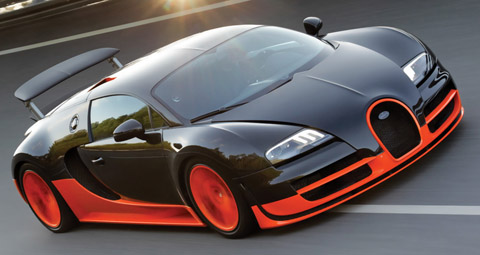
1. Bugatti Veyron: 267 mph, 0-60 in 2.5 secs. Aluminum, Narrow Angle 8 Liter W16 Engine with 1200 hp, base price is $1,700,000. The Super Sport version is $2,400,000. The speed was tested again on July 10, 2010 with the new 2010 Super Sport Version: the Bugatti Veyron once again claims the title of the fastest car in the world at 267 mph.

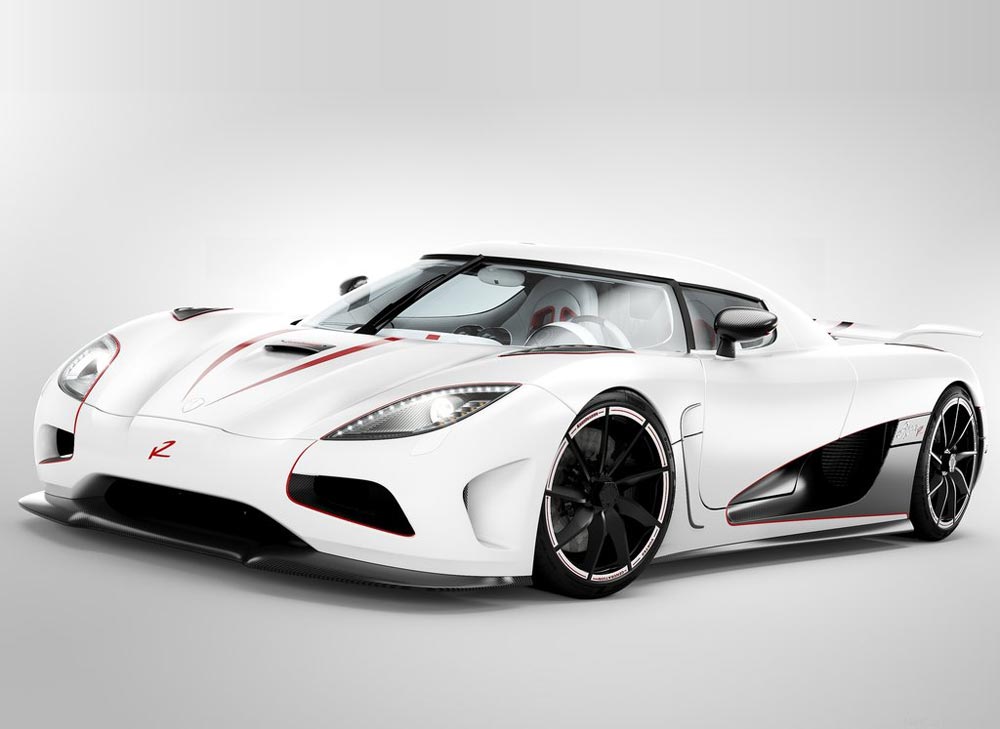
2. Koenigsegg Agera R: 260 mph, 0-60 in 2.8 secs. 5.0-liter V8 Engine with twin turbo’s, housing 1099 hp. Base price is $1,600,000. If you're into snow sports, the Agera R can be fitted with a Ski Box as well as winter tires, not that I would take one on a ski trip or anything like that. While the Agera R has a massive theoretical top speed, the current tested top speed is 260 mph. Expect this snow car to be the Bugatti's arch enemy for the next 5 years.
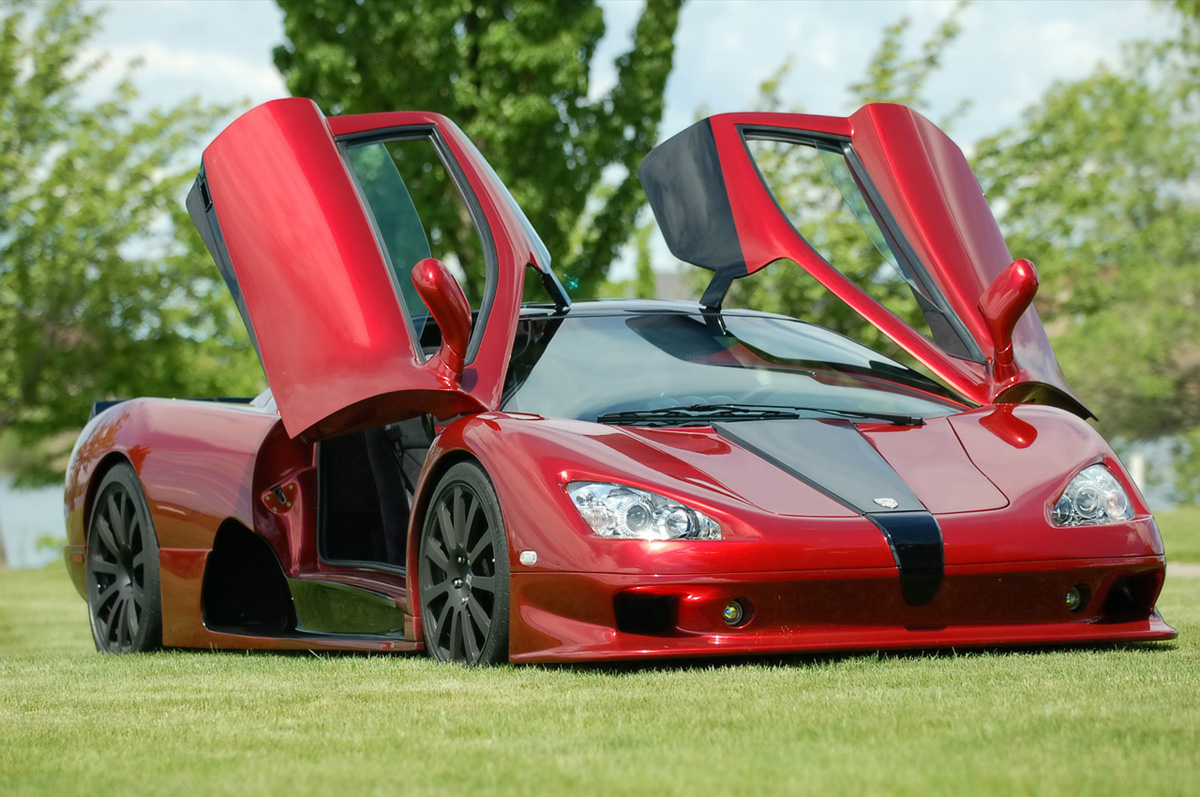
3. SSC Ultimate Aero: 257 mph, 0-60 in 2.7 secs. Twin-Turbo V8 Engine with 1183 hp, base price is $654,400. Tested in March 2007 by Guinness World Records, The SSC Ultimate Aero was the fastest car in the world from March 2007 to July 2010. On March 2011, the Koenigsegg Agera R also surpassed it, forcing this American made car to the #3 spot.
SSC Ultimate Aero Red doors open
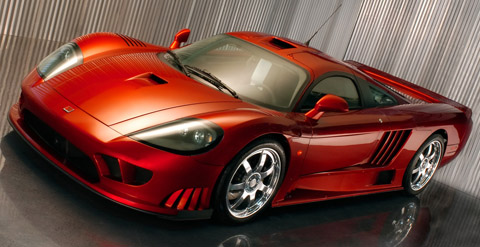
4. Saleen S7 Twin-Turbo: 248 mph, 0-60 in 3.2 secs. Twin Turbo All Aluminum V8 Engine with 750 hp, base price is $555,000. Smooth and bad-ass. It will make you want to show it off non-stop.
Saleen S7 Twin Turbo dark orange front view
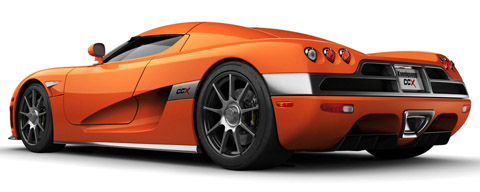
5. Koenigsegg CCX: 245 mph, 0-60 in 3.2 secs. 90 Degree V8 Engine 806 hp, base price is $545,568. Made in Sweden, it is the older brother of the Agera R, only losing to 4 other supercars in the world.
Orange Koenigsegg CCX
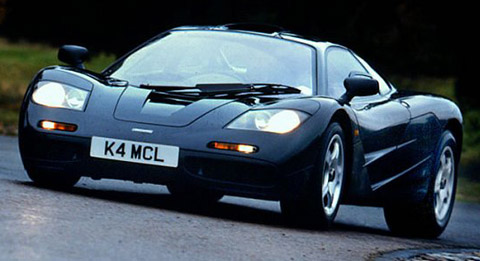
6. McLaren F1: 240 mph, 0-60 in 3.2 secs. BMW S70/2 60 Degree V12 Engine with 627 hp, base price is $970,000. The fastest car in the 20th century with doors that looks like bat wings. Maybe Batman needs to order one and paint it black 1997 McLaren F1 on the road black
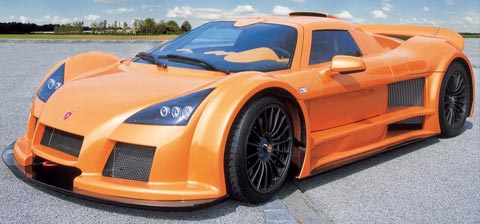
7. Gumpert Apollo: 224 mph, 0-60 in 3.0 secs, 4.2 liter V8 Engine that houses 650 hp. Base price: $450,000. Gumpert claims that the Apollo was designed such that it could drive upside-down in a tunnel with speeds at 190 mph or above. Of course, no one has tested this yet.
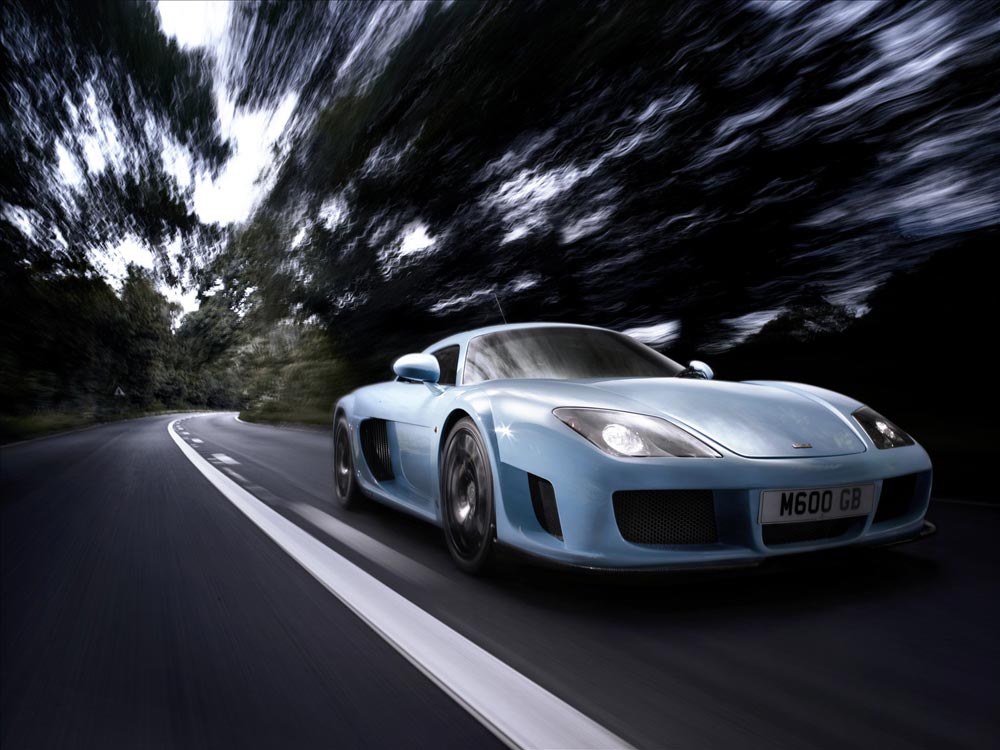
8. Noble M600: 223 mph, 0-60 in 3.7 secs. Twin-turbocharged 4.4-liter V8 Engine with 650 hp. Base price is $330,000. The Noble M600 also happens to be a very cool car. Its inconspicuous design sports a slender and contoured body which does not scream out for attention at every second of the day.
We have a tie for 9th and 10th places:
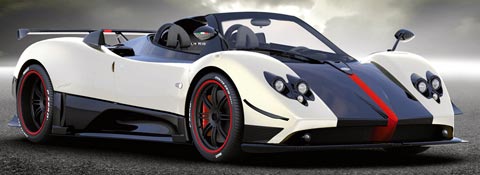
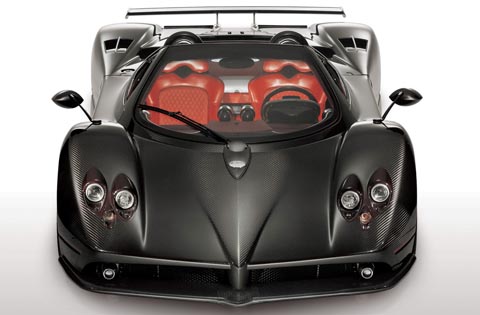
9. Pagani Zonda Cinque Roadster: 217 mph, 0-60 in 3.4 secs. Twin turbocharged AMG V12 engine that produces 678 hp. Base price is $1,850,000. The Pagani Zonda Cinque Roadster is a limited-edition, with five ever produced. It is the quintessential exotic and exclusive supercar.
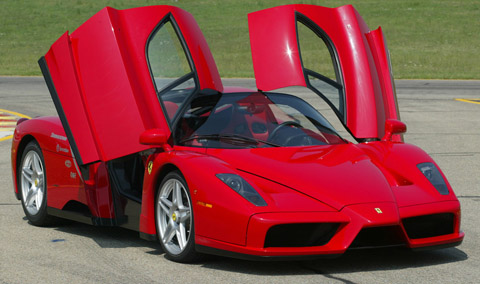
9. Ferrari Enzo: 217 mph, 0-60 in 3.4 secs. F140 Aluminum V12 Engine with 660 hp, base price is $670,000. Only 399 were ever produced; the price goes up every time someone crashes.Ferrari Enzo doors open front view
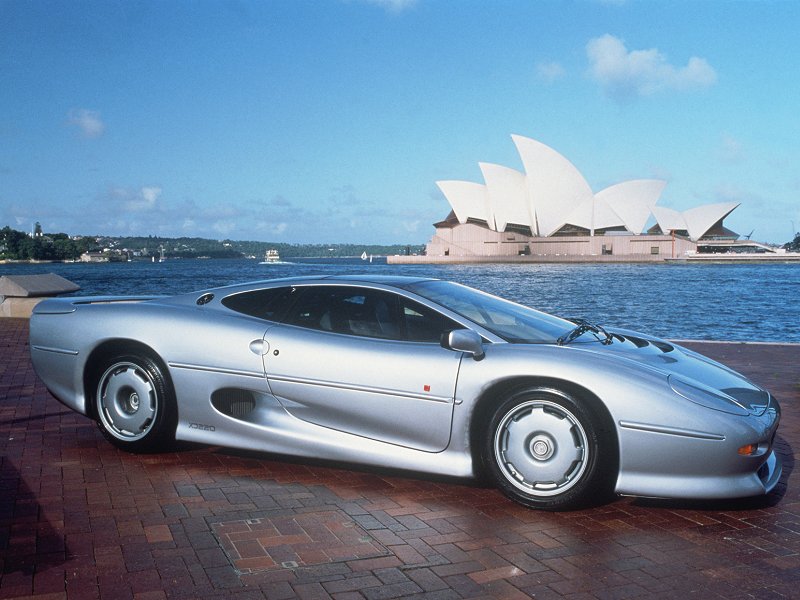
9. Jaguar XJ220: 217 mph, 0-60 in 3.8 secs. Twin Turbo V6 Engine with 542 hp, base price was $650,000. Made in 1992, this car still has what it takes to make the list.
Jaguar XJ220
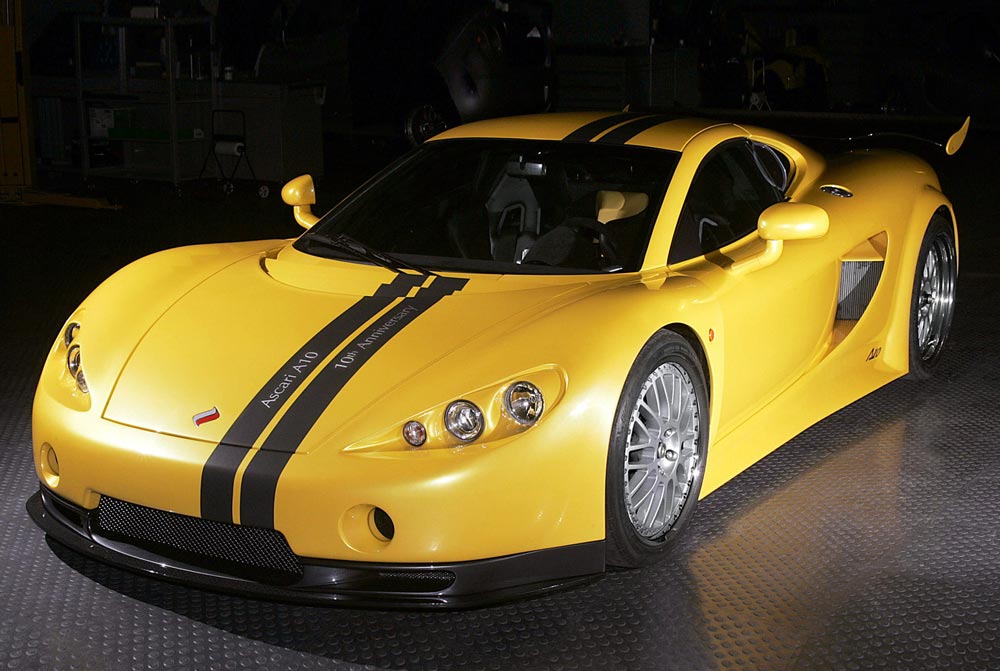
10. Ascari A10: 215 mph, 0-60 in 2.8 secs. 5.0 litre BMW V8 S62 Engine with 625 hp. Base price: $650,000. The company planned to produce 50 of these supercars at its factory in Banbury, England.
10. Pagani Zonda F: 215 mph, 0-60 in 3.5 secs. Mercedes Benz M180 V12 Engine with 650 hp, base price is $667,321. With a V12 motor, this baby can do much better.

pagani zonda f
Source : thesupercars.org

BMW i8 Concept - New Car 2011

It’s been nearly two years since BMW’s Vision EfficientDynamics concept debuted at the 2009 Frankfurt show, and the car has now officially re-emerged one step closer to production as the BMW i8 concept. As you can see, little has changed in the styling department. In fact, other than a new wheel design, the only other notable change we’ve spotted concerns the doors, which seem to have claimed some territory along their bottoms and thereby reduced the size of the blue body-side accent. Interestingly, the car didn’t show that change when BMW paraded it around for spy photographers this past March, but we like it.
Passenger Compartment + Powertrain = LifeDrive
As with the i3 city car concept that debuted at the same time , the story of the i8 begins with its LifeDrive architecture. BMW says that its experiences in creating the Mini E and 1-series-based BMW ActiveE showed that adapting cars engineered for internal-combustion power to electric propulsion results in a lot of excess weight and compromises in packaging. As a result, both the i8 and i3 are built using two purpose-built modules: one to house passengers, dubbed “Life,” and one for propulsion and suspension components, called “Drive.” Combine them, and you have a car—and marketing-friendly “LifeDrive” branding.
While the i3 and i8 share the LifeDrive architectural philosophy, the cars differ in execution. That’s because the i3 is fully electric, while this i8 is a plug-in hybrid, so its Drive component is actually split in two, with an electric motor at the front axle and a gas engine at the rear. Unlike the i3, which situates its batteries below the passenger compartment, the i8’s lithium-ion cells are actually part of the Life module, stacked through a central tunnel that might house a transmission and driveshaft in a conventional car. Arranging them this way allowed BMW’s engineers to achieve yet another claim of perfect 50/50 weight distribution, thereby preserving peace in the city of Munich. As in the i3, the i8’s Drive components are largely crafted of aluminum, while the life module uses a carbon-fiber-reinforced plastic monocoque. Using so much lightweight material essentially cancels out the added weight of the heavy electric drive components, thereby allowing the car to weigh less than 3300 pounds, according to BMW. The rigidity imparted by the carbon fiber also allows for long, dramatic doors that ease access to the two small rear seats, and is a boon to crashworthiness, too.


While most other so-called “through-the-road” hybrids (meaning the propulsion systems each drive their own axle) are based on existing front-drive vehicles—meaning they add electric power to the rear wheels—BMW had the luxury of starting from scratch. Because most braking energy gathers at the front of the vehicle, the i8 has its electric motor up front for the sake of recapturing energy. The motor is shared with the i3, and its peak output is 170 hp and 184 lb-ft or torque. It’s fed juice, of course, by those lithium-ions, which take about two hours to charge and return 20 miles of all-electric driving.
Three’s Company: 220-Horse Three-Cylinder
The original Vision EfficientDynamics concept used a three-cylinder turbo-diesel engine, but the i8 makes use of BMW’s new gas-fired 1.5-liter turbo three-cylinder, which we first reported on in April. It makes 220 hp and 221 lb-ft of torque, helping the i8 to its governed top speed of 155 mph. The run to 60 mph will come in under five seconds, says BMW, who also claims the i8 will return 78 mpg on the European cycle. But that test is notoriously optimistic, and the company says normal driving will realistically result in economy of just half that figure. The engine and electric motor can power the car on their own or in tandem for better traction, with the stability-control system’s whims playing a large part in deciding when to team them up. Each axle also contributes regenerative electricity; the front houses the regenerative braking system, while the engine at the rear has a high-voltage alternator that can recapture energy. No mention was made regarding what type of transmission is installed in the i8.
A button-activated “Eco Pro” mode dulls throttle response, caps speed between 56 and 74 mph, and reduces the load of the climate-control system. (Because the climate-control system also is responsible for keeping the batteries at an operating temperature of 68 degrees, it always runs to some extent, however.) The i8 also features an intelligent navigation system that can decide the most energy-efficient route to a destination.


What i Looks Like
While not much has changed about the i8’s styling, a few themes have emerged now that it has a sibling in the i3. The laying of white panels over a black and clear sub-layer is meant to reference the car’s Life and Drive components. Besides just looking flat-out futuristic, BMW i models will be marked by a BMW roundel with a blue ring around the outside, blue accents on the grilles and side sills, and the “stream flow” C-pillar treatment.
Inside, the i8 concept foregoes traditional gauges in exchange for a more future-tech 8.8-inch display screen for reporting road and engine speed, as well as battery and fuel levels. In Eco Pro mode, the digital gauges glow blue; in Sport mode—details of which were in short supply—they glow orange. A second screen tops the dash above the center stack to display navigation and infotainment functions, and the rest of the interior is clean and simple.
Yes, the i8 is technically a concept, although in typical BMW fashion, it’s pretty well fleshed out and likely very close to what you’ll see when the production car launches in 2014. While the diminutive i3 is certainly intended to capture the attention of the general public, the i8 appears to be an effort to keep enthusiasts under the BMW umbrella as sustainability and efficiency become increasingly important. While it remains to be seen if the i8 will be satisfying to pilot, we applaud the idea, since there’s not much that we want to see more than a long future for driver’s cars.Source : Caranddriver.com

Saturday, July 23, 2011

Tomorrow's Ferrari is a hybrid sports car wrapped in carbon fiber

Tomorrow's Ferrari is a hybrid sports car wrapped in carbon fiber

Three things come to mind when you think of the brand Ferrari: red, fast and expensive. Maybe, even Italian. Ferrari wrapped up its 2011 World Design Contest that pitted designs students from over 50 schools from around the world to design a "hypercar whose design reflects social changes and technical innovation without sacrificing the brand's performance and iconic appearance."
Three South Korean design students took first place with their Ferrari Eternity concept car — the future of Ferrari. Excuse us, while we wipe the drool off our chins.

Design students Kim Cheong Ju, Ahn Dre and Lee Sahngseok from Hongik University smoked competitors from Turin and London with their hybrid electric sports car.
The Eternity's body is made entirely out of carbon fiber to keep it light and coated in lithium to give power to the car's engine. It runs off a hydrogen fueled engine with a "Fly-Wheel Energy Storage" that cranks miles on electric as a backup. "Maglev System Wheels" were also included to reduce friction and ensure the Eternity drives smoothly.
While the Eternity's design embodies everything Ferrari's are famous for, I personally would have picked third-place winner Henry Cloke and Qi Haitao's Cavallo Bianco car, a hunk of sleek silver with concealed wheels that looks all sci-fi-ish.
Source : dvice.com

2012 Mercedes-Benz C63 AMG Coupe Black Series

2012 Mercedes-Benz C63 AMG Coupe Black Series

The latest in a very short but highly distinguished—and completely nuts—line of Black Series Benzes is here. The C63 AMG Black Series is based on the C63 coupe, which we just drove for the first time a few months ago. Following the lead of the not-for-U.S.-sale SLK55 Black Series, the CLK63 Black Series, and the SL65 Black Series, this C63 AMG is amped up visually and dynamically, with a steroidal bump in output to back up the flared nostrils.
In case the 451 hp and 443 lb-ft in the standard-issue C63 AMG or the 481 and 443 offered by that car’s AMG Development Package aren’t quite cutting it, the C63 AMG BS makes 510 hp at 6800 rpm and 457 lb-ft at 5200. Like cars with the Development Pack, the Black Series borrows its pistons, connecting rods, and crankshaft from the be-gullwinged SLS AMG supercar. Behind the motor lives the same seven-speed automatic found in the regular C63, packing four shift modes and a launch-control function for when you really don’t want to linger at this stupid party one more split second. We ran a Development Pack sedan to 60 mph in just 3.9 seconds; with wider rear rubber, figure on the Black Series shaving a couple tenths from that and clearing the quarter-mile in around 12 seconds flat.


I’m Going to Eat You
Like the Black Series cars that came before it, the C63 oozes menace and purpose. Air can’t flow through stuff, so there’s remarkably little material remaining in the front fascia, the bumper that once resided there largely displaced by intakes covered by black mesh. A gaping central intake is flanked by two smaller holes through which cooling air enters, and two nostrils atop the hood give hot air a convenient exit from underhood. As if to emphasize its name and purpose, the front splitter comes to a sharp point in the middle of the nose.
Flared fenders widen the car by 2.2 inches up front and 3.3 out back, covering tracks stretched by 1.6 and 3.1 inches, respectively. Vents behind the front wheels and ahead of the rears are both nonfunctional, which somewhat diminishes their awesomeness. The lightweight wheels at each corner have their movements controlled by adjustable coil-overs, while speed-sensitive steering issues directional orders and Black Series–specific anti-roll bars maintain the contact patches during aggressive driving. The brake rotors measure 15.4 inches in diameter up front and 14.2 inches out back. Red paint is standard on the calipers, which have six pistons up front and four in the rear. The rubber measures 255/35-19 up front and 285/30-19 out back—that’s up from 235/40-18s and 255/35-18s on the basic C63 AMG coupe—and a limited-slip diff is standard, as is a stability-control system that will get entirely out of the way if you want it to.


Flat Bottom Girls
You’ll notice hard-shell sport buckets in the accompanying photos, but those aren’t likely to make it to the U.S. We are likely, however, to at least get red stitching on whatever seats we do end up with. Calm down. The rear seat has been dismissed in the interest of weight savings, but can be reactivated if you’d like to frighten more than just one person at a time. And AMG has flattened both the bottom and top of the steering wheel, which makes it way more serious than all those wheels with just flat bottoms. Lest the screaming V-8 deafen your passenger to the point they can no longer hear the V-8 screaming, a Black Series logo on the dash will remind them why they can’t hear.
Those who feel the flared and vented look of the C63 AMG Black Series isn’t quite enough will be able to crank up the appearance even more with an AMG Aerodynamics package that includes carbon-fiber winglets on the front valance and a fixed carbon-fiber spoiler with an adjustable aerofoil. AMG says these bits are functional and increase downforce, but isn’t saying by how much. It also won’t provide photos of a car so equipped, so we don’t know by how much they make it look more menacing and/or ridiculous. The C63 Black’s other major option package is a Track pack that includes even higher-performance rubber of unspecified Dunlop pedigree, as well as a differential cooler.
All Black Series cars to this point have been low-production affairs, the SLK55 AMG, for example, being limited to just 120 units. The CLK63 and SL65 sold in slightly higher numbers, at 700 and 350, respectively. While Mercedes isn’t saying yet how many C63 AMG Black Series it will build, representatives do tell us the number will be capped. Figure on a sticker edging close to $100,000. While that’s awfully steep for a car that shares its basic shape and structure with a coupe starting in the mid-$30,000 range, it is about $40,000 cheaper than the CLK63 Black Series and a whopping $200K less than the SL65 Black Series. So if you’ve got a spot reserved in your garage for what will certainly be the cheapest U.S.-market Black Series car yet, get on the horn to your dealer now. U.S. distribution will begin early in 2012.
 
Source : Caranddriver.com

Sunday, July 10, 2011

2012 Mercedes-Benz CLS550 - Short Take Road Test

It's an age-old automotive-design problem—how do you fix what isn't broken? How do you update a timeless shape?
There are two possible answers: One, you tweak it a little, à la Mini Cooper, until your shape is neither new nor old. Or two, you start over, Jaguar XJ–style, throwing everything out the window and starting fresh. Best case, you end up with something revolutionary. Worst case, you get a hacked-up rehash that just reminds you of what you've lost.
Bigger and More Muscular
Well, there is a third possibility: somewhere in between, and that’s what we have here. When it was launched in the United States in 2005, the Mercedes-Benz CLS turned heads; the "four-door coupe" oxymoron suddenly made some sense. Even though the car was little more than a rebodied E-class, 40,000 examples whizzed out of American dealers in five years. Now we have a new CLS for 2012.
Meet the new oxymoron, not quite the old. You will note that it looks different. Kind of. Also note that it’s still fundamentally an E-class. Wheelbase is up, from 112.4 inches to 113.2, and overall length has jumped by nearly an inch. Height and width increase too, as do the front and rear tracks. The biggest difference is the lack of a naturally aspirated powerplant. In place of the old car's 5.5-liter V-8, the CLS550 now sports a 4.7-liter, direct-injection, twin-turbo V-8, the same engine used in the humongous 2011 CL550 4MATIC coupe and proliferating throughout the Merc lineup in the coming years.
Power is down from the CL—402 versus 429—as is torque, from 516 lb-ft to 443. This is still 20 hp and 52 lb-ft more than the last-gen CLS550 offered, and the 4.7-liter goes like the clappers: Hitting 60 mph requires just 4.2 seconds and the quarter passes in 12.8 at 112 mph. Even so, we can’t help missing the CL's extra bit of shove. (Disclaimer: The CL550 thumps its way across the landscape with the kind of seamless urge usually found in booster rockets. We miss its shove in everything.) A smooth-shifting seven-speed automatic is the only transmission available in the CLS550. If you're absolutely desperate for more grunt, a 518- or 550-hp, 5.5-liter twin-turbo V-8 can be found in the CLS63 AMG. And no, we don't understand the naming scheme, either.
Capable but Cautious
This is a big car—it tipped our scales at more than 4100 pounds—and it drives like one. The plushly appointed cabin is comfortable, the heavily bolstered seats seemingly good for thousand-mile days. But the low roofline lends a small-car feel, and you end up tossing the CLS around like you would a much smaller machine.
Chassis behavior is predictable and entertaining but won't surprise anyone. The standard Airmatic air suspension works well enough on winding pavement but doesn’t like being rushed; you spend a lot of time waiting for the nose to take a set, for the back end to settle down, for the rest of the car to make it through the corner. Grip on a smooth skidpad is a commendable 0.89 g, but truly crazed asphalt can bind things up to the point where the car simply gives up and throws in a stability-controlled brake application to yank everything back down again.
The brakes are simply unflappable, with short pedal travel and surprising fade resistance in hard street driving, and they turned in an impressive 163-foot stop from 70 mph. The electric power steering is accurate and possessed of classic Mercedes heft. All in all, it’s a nice, quick package, if not an overly sporty or aggressive one.
https://blogger.googleusercontent.com/img/b/R29vZ2xl/AVvXsEgnjM4VKg1qe25P-p5-hSZF7d8QarqTFXzD9VY9Vcu3PO9Idzk-FgOlzuqkgB4vKxzi11eEqN9u8TIqa1x5VUw6jgvkNQHxjgaCNZxinyZeVcuV8YUrwYZEAaMTqj2c-FpTaYffyydBySM/s1600/2012-mercedes-benz-cls550-4matic.jpeg+w%253D540%2526h%253D403.jpeg
Okay, so the styling occasionally seems forced, with too many angry-face fillips and none of the previous CLS’s elegance. But the 2012 CLS550 is still more stylish than the E-class sedan, and if you’re not enamored of the new sheetmetal, consider this: From the driver’s seat, all you see is the road.
source : Caranddriver.com

Friday, July 8, 2011

Honda S2000, 2000-2009 - Used Vehicle Review

Read about the Autos.ca Used Vehicle Review: Honda S2000, 2000-2009
You might have called it Honda’s mid-life crisis, but unlike the 50 year-olds who go out and buy a sports car, Honda celebrated its 50th by building one.
A sporty Honda isn’t tough to wrap your head around, but for a company whose most overtly sporty car to that point was a Civic with 160 horsepower, the S2000 was Honda’s and-now-for something-completely-different moment, with a screaming 9,000-rpm four-cylinder good for 240 horses.
At the time, the S2000′s engine boasted the highest specific power per volume of any naturally-aspirated (that is, not turbo- or supercharged) production motor. That is to say, it produced more power per litre of displacement than any other naturally-aspirated engine in a car available in a showroom. The motor was mated to a standard six-speed manual transmission (the only one available) and a Torsen limited slip differential.
Used Vehicle Review: Honda S2000, 2000 2009 auto articles
In 2004, Honda made some cosmetic and mechanical tweaks to the S2000. Most significantly, these included bumping the engine’s displacement to 2.2 litres by way of a longer piston stroke; horsepower remained the same, but torque increased to 162 lb-ft at 6,200 from the previous peak of 153 lb-ft at 7,500 rpm. The longer stroke resulted in a lower redline of 8,000 rpm.
In addition to the larger motor, the transmission got shorter ratios for gears one through four and taller ratios for fifth and sixth.
In 2006, Honda added a drive-by-wire throttle and Vehicle Stability Assist.
For 2008, the S2000 gained a tire pressure monitoring system, updated dash and gauges and a few new colours.
For a full list of differences between 2000-2003 and 2004-2009 cars, check this thread.
In typical Honda fashion, fuel consumption is decidedly palatable for a sports car, with EnerGuide ratings of 11.8 L/100 km (city) and 8.4 L/100 km (highway). Autos.ca contributors Paul Williams and Frank Rizzuti, both S2000 owners, report that those figures are quite realistic in real-world driving. Premium fuel is a requirement, though. Reliability has been solid, generally, but Consumer Reports (CR) data indicates a few things to watch for. One is what CR dubs the potential for “major” engine problems in 2003 through 2005 models. The publication doesn’t provide specifics, but possibilities include a stuttering engine caused by a bad manifold air pressure (MAP) sensor or an ignition system misfire, which can be caused by any number of things. Source : autos.ca

Thursday, June 30, 2011

2011 Nissan 370Z Sport Review - CARS REVIEWS 2011

2011 Nissan 370ZPros:

Great improvement over the successful 350Z
Nice body lines, Rays wheels are icing on the cake
Powerful motor with great sound
GTR influence

Cons:

Manual transmission not as slick as the competition
No lumbar support or telescoping steering wheel
Either less weight or more power and this could be an exotic challenger for a fraction of the cost

41 years ago Nissan (Datsun in the US) launched the 240Z onto our shores and turned the sports car market on its head. Here was a light, nimble, reliable, value oriented sports coupe for two which had decent cargo capacity. I had the pleasure of owning and wrenching on various Z cars through the 300ZX and still found the 240Z to be the purist of them all. Only when Nissan introduced the 350Z in 2003 did it appear that they had something of real value that could match their original Z sports car.

2011 Nissan 370Z

Just like the Porsche 911, Nissan has raised the level of performance and comfort through the years while paying tribute to its Spartan roots. Sure Porsche got a big head start (approximately 6 years), but Nissan has paid close attention to the formula which Porsche, and Chevrolet with the Corvette, have successfully followed through the years. Now the latest incarnation of the Z has brought this car very close to the level of its big brother GTR, but falls short in a few areas we will discuss later. Address these issues and keep the sticker under $40k, and except for some small back seats, the Z could overtake the GTR. Sound like the Cayman-911 argument? déjà-vu.

Design

From the early days of the 240-Z through the 300ZX years, Z cars were influenced by everything from the likes of Jaguar, Chevrolet, Ferrari and even Lotus; a Japanese version of these cars if you will. With the 350Z, Nissan took its La Jolla California design studio concept and brought it to production, and it was an instant hit. This sixth generation 370Z has improved the concept further by building out the fender flares and sharing design cues from the GTR, which share the same E platform as the current Infiniti G Coupe, FX, and Renault Alpine. It’s wider than the 350Z (read grip), and shorter than the previous Z (read quicker turning.)

Nissan 370Z 19-inch 5-spoke RAYS® super-lightweight forged alloy wheels

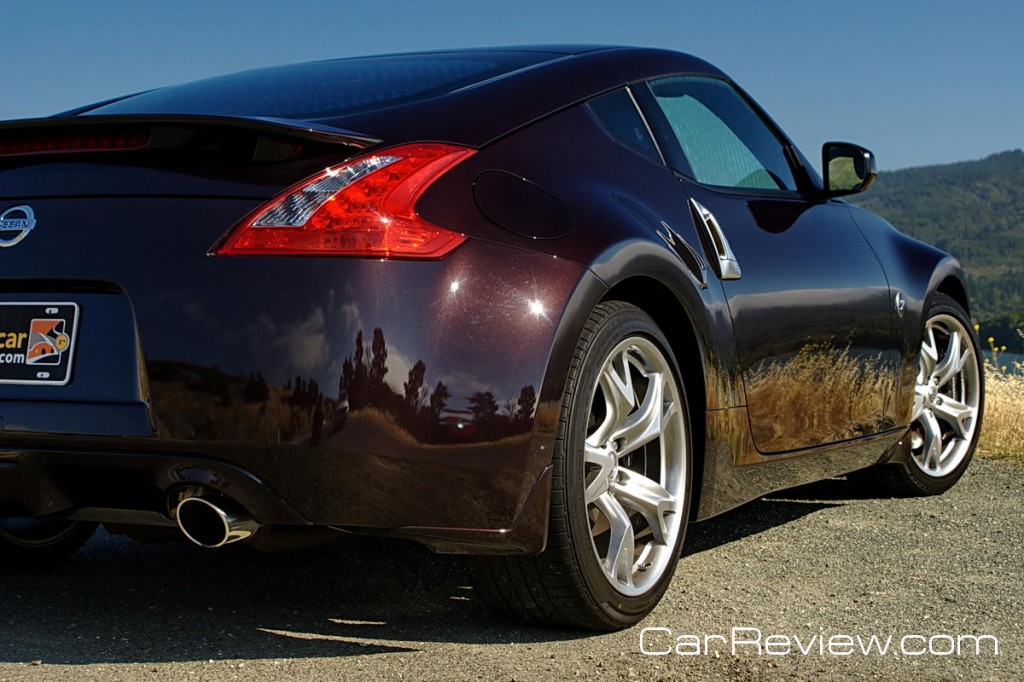
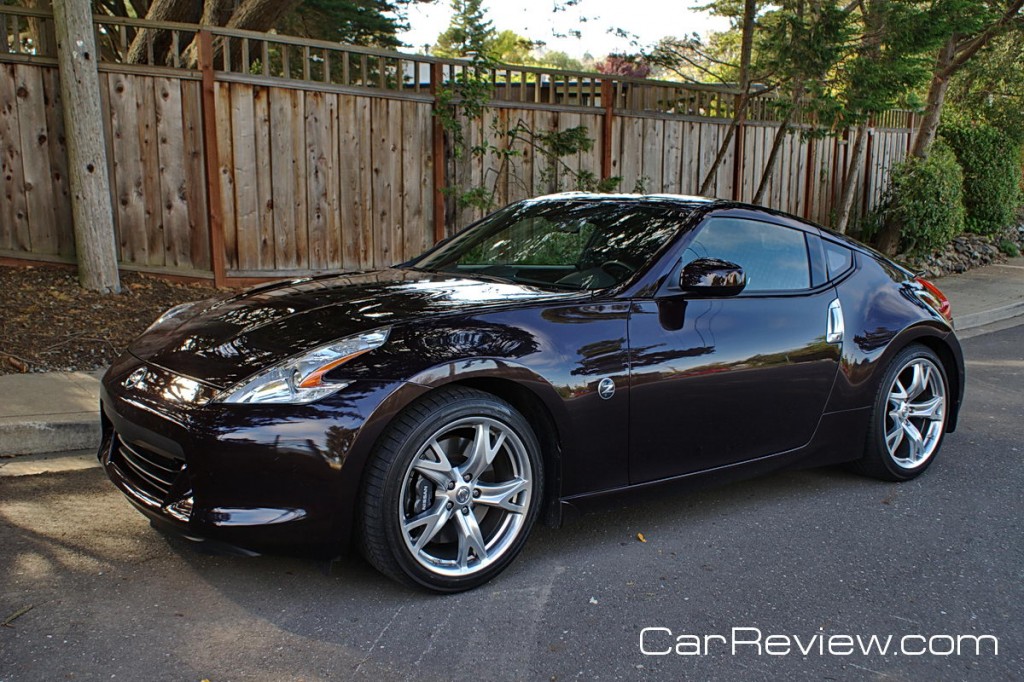
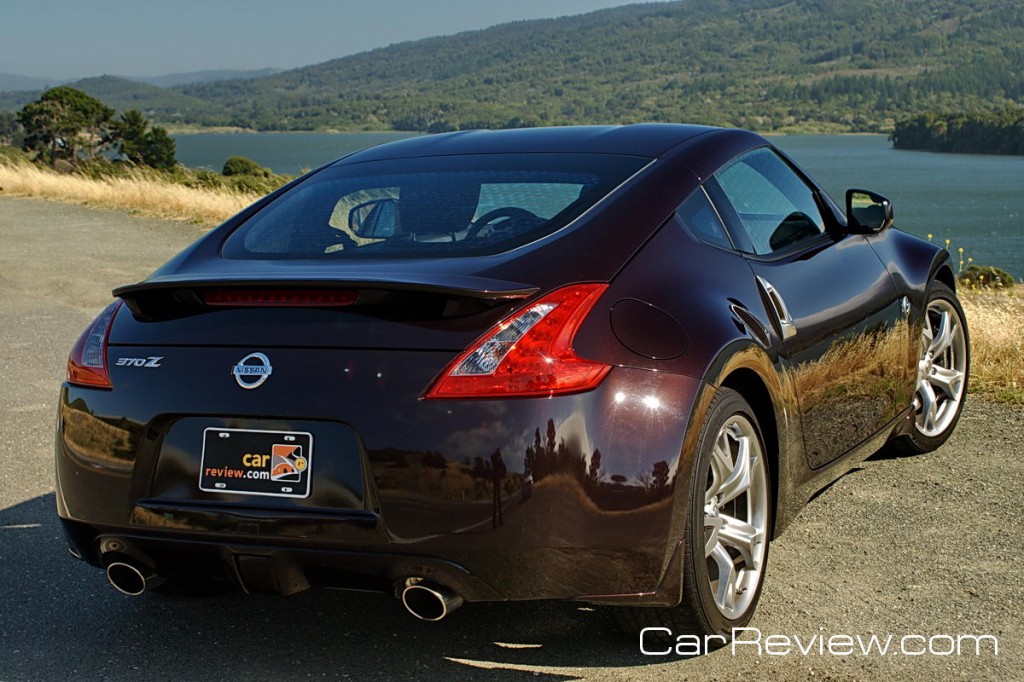
The exterior fender flares results in a menacing look without being portrayed as a silly phallic symbol. When traffic approaches from the rear side, eyes will be pinned on the fenders and the beautiful Rays wheels our test car was equipped with. From all angles, the Z looks like it means business. The front bumper has GTR influences and also looks equally menacing on approach, so much so that mothers with small children quickly gathered the tykes as we rolled down neighborhood streets. It makes a statement like no other car with an under $30k base price. Our test car had an unusual Black Cherry paint finish, but the 370Z really looks best in bright silver.
2011 Nissan 370Z
Drive Impressions
This is the truest version of the 370Z; the base car with the Sport Package ($3000), adding limited slip, 19” Rays Wheels, front and rear spoilers, and larger front brakes. Along with this comes a $580 add on for the matching Nismo brake pads. The finely tuned 3.7L engine makes 332 hp and launches the Z down the road with one of the best sounds from a V6 engine, powerful and smooth.  Acceleration is pretty fierce and the amount of grip with the 275’s out back is serious. We turned off the traction control and the Z felt planted in the twisties, with plenty of torque to pull it up the most aggressive mountain roads with ease.
We mentioned that the 370Z has a shorter wheelbase than the 350Z, resulting is a faster turning car, but with that you get more jounce in the ride, especially over rough surfaces. Luckily, Nissan did a great job tuning the non-sport mode suspension to be fairly compliant, saving our brains on long freeway drives.
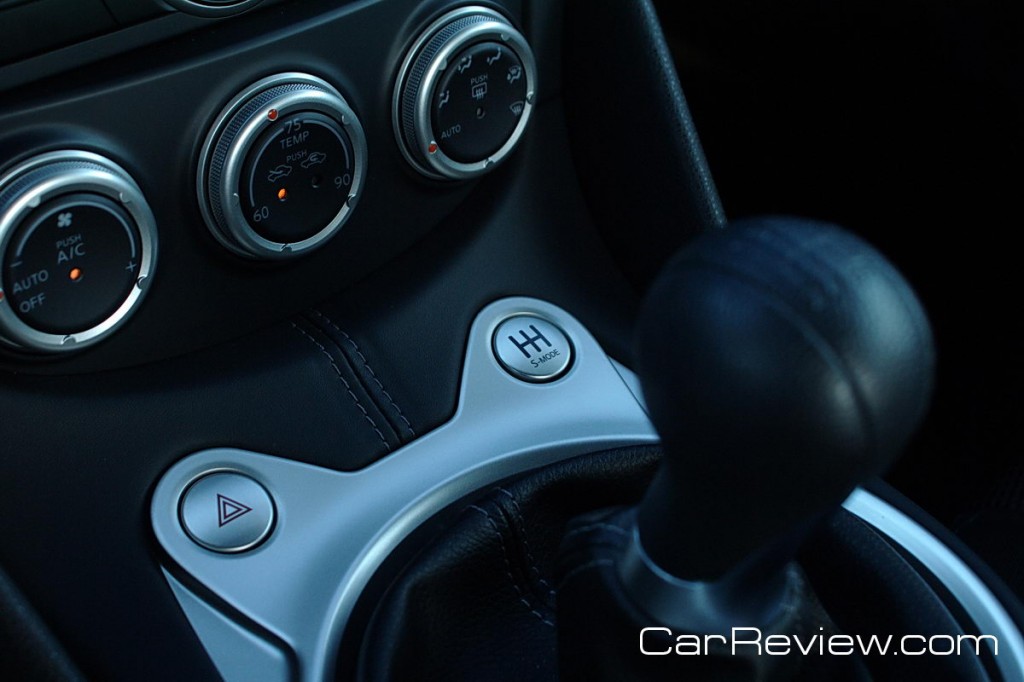
Nissan 370Z SynchroRev Match® manual transmission
The Z’s manual transmission is probably the weak point of the whole car, not the ratios but the long throws of the shifter and clutch. This becomes most apparent when trying to go fast. We loved the sport mode, which stiffened the suspension, created more top end power from the motor, and activated the SynchroRev Match®, but this still didn’t address the throws of the transmission. We would suggest a dual clutch semi automatic transmission similar to the GTR, as that will shift faster than 99% of the humans out there. The wheels and tires were great, but Nissan could probably widen them another inch and still clear the fenders.
Nissan is at a point where the 370Z is getting eerily close to the flagship GTR in performance and looks. In fact, the 370Z tends to be more noticeable due to its aggressive fenders, beautiful wheels, and low stance. If they added 90 hp to the motor and AWD, it would be an R8 or Gallardo contender for less than $45k. Nissan has the platform, but a 370Z set up this way might obviate the need to produce the Skyline, or at least to carry it in this country. Sorry GTR fans, but 600 lbs is 600 lbs.
Nissan 370Z dash mounted cluster gauges
Comfort and Convenience
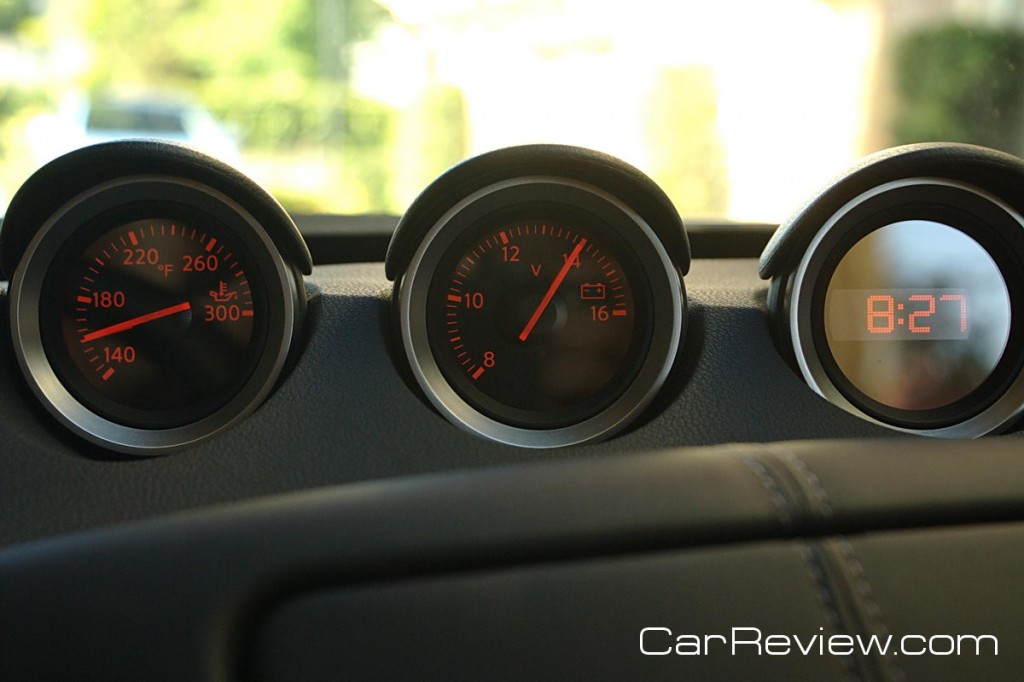
Just like the exterior, the interior is all business; no navigation, no XM radio, no power seats, not even leather; all of this kept our test car below a 3300 pound curb weight. Just a simple black interior with gray accents, along with tasteful brushed aluminum weaved into the scheme. The gauges are a combination of analog and digital, and strike a balance that makes immediate sense to the uninitiated, with the center dash being the traditional clock, oil temp and volt meter. Interior fit and finish is very good and up to the level of Nissan’s best. Materials and appearance are great; they didn’t try to get all fancy, so everything looks like it belongs.
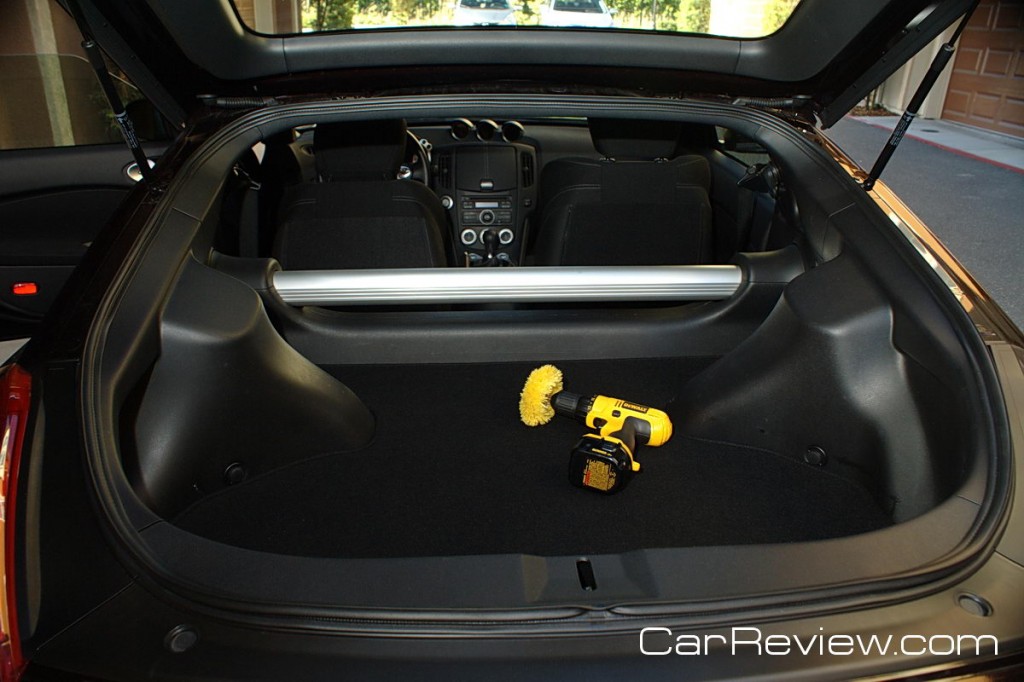
Although the seating is low and comfortable, the Z could accommodate more drivers with a telescoping wheel, manually adjustable seat bolsters and a lumbar support. Most of our test drivers liked the eight way manually adjustable driver’s seat once they spent a little time making those adjustments. Owners of the 370Z learn to travel light. There is a tray (to place a small bag) and a compartment behind each seat, which expands storage beyond the rear area under the hatchback. There is only one cup holder, two bottle holders in the door panels, and no sunglass compartment at ceiling level; again all business.

2011 Nissan 370Z rear cargo area and chassis brace
This Z is more aggressive in exterior design than its predecessor and this becomes apparent when you have to go into reverse or change lanes, as rearward vision is somewhat limited; better than a Gallardo or R8, but still limited. It helped to open the window when backing into parking slots. The 2011 370Z claims to have more fender well and undercar insulation than the 2010 370Z, but the optional sport package tires still brought in a lot of road noise at freeway speeds. The car could also benefit from wind tunnel testing with the windows down, at speeds above 25 mph there is a distinct buffeting flutter when the windows are rolled down.
At Home on the Road or at the Track
The 370Z is probably one of the most purposeful 2 seat sports coupes made today. It can be driven calmly as a daily driver and can double as a canyon or track attack vehicle. It has aggressive lines that make an instant statement (almost exotic) when you pull up in front of your friends. Nissan makes no difference in output between their base and touring models (save Nismo with 20 more HP), so out of the box the engine propels the car to 60 in under 5 seconds. Overall mileage was about 19 MPG; keep in mind there was a lot of pedal to the metal during the weekend test.
2011 Nissan 370Z
Yes there are other practical 2+2 sports coupes available for less than $35k, like the American Pony Cars or Hyundai Genesis, but if you are looking for a purpose built two seat coupe you can live with every day, this is the one. The closest competitors are the Corvette and Cayman, but these move you $10k higher without the striking looks. This is an excellent value for a performance ride, just make sure you test both the manual and automatic transmissions before buying. Nissan is really pushing their 370Z slogan; Passionate Performance at an Excellent Value. It’s 1970 all over again, just in a Z that’s 2X faster and 5X more comfortable than the original Datsun.

BUILD INTERIOR PERFORMANCE HANDLING STYLING VALUE OVERALL
RATING 4.25 4.25 4.75 4.5 4.75 4.5 4.5 / A-
 Source : Carreview.com

Sunday, June 26, 2011

New Cars - Hyundai Elantra

http://www.analogstereo.com/images/om/hyundai_elantra.jpg
Hyundai Reviews -  One of the likely consequences of the federal government's push for more stringent fuel economy standards is that more people will be driving smaller cars in the future. Not too long ago, with the exception of a few distinguished compact cars, that didn't look like a very appealing reality.
That's changed with the debut of efficient models like the Chevrolet Cruze, the upcoming 2012 Ford Focus and now the redesigned Hyundai Elantra. The Elantra has all the makings of a sales success: stop-and-stare styling, a fuel-sipping four-cylinder engine and an optimal blend of ride comfort and handling poise — all at a competitive price.
In short, the Elantra is a home run in the compact segment, allowing more drivers to happily enter a fuel-efficient future.
The 2011 Elantra sedan is available at Hyundai dealerships now and is offered in two trim levels: base GLS and upscale Limited. I tested automatic-transmission versions of both trims; click here for a side-by-side comparison of the two models.
Styling
The redesigned Elantra makes a good case for being the most stylish new compact sedan on the market. The car's designer, Cedric D'Andre, said one of the goals of the design was to create a car that was at least as sporty-looking as the Honda Civic, which still has a modern look even though it hasn't been fully redesigned since the 2006 model year. Hyundai has definitely met its goal, as the Elantra's styling is as dynamic as it gets in this class.
http://images.thetruthaboutcars.com/2009/08/2009_hyundai_elantra-touring-5.jpg
Like the Civic, the Elantra's front roof pillars have been stretched toward the front fenders, resulting in a windshield with greater rake. This gives the car a streamlined appearance, but the left pillar blocks your view a little when navigating winding roads. The car has the look of a coupe as the rear window stretches nearly to the tail, resulting in a short trunklid.
Besides the appealing proportions, there's also a bit of visual flair almost everywhere you look. Pronounced hood and door creases, arching fender flares and a trunklid lip spoiler all contribute to a level of sophistication that's been mostly absent in compact-car designs, until recently. I'd been wondering what car was going to challenge the new Focus from a styling standpoint, and with the new Elantra that question has been answered — and then some.
Efficiency & Drivability
https://blogger.googleusercontent.com/img/b/R29vZ2xl/AVvXsEgN7Vi4rje_tQNby-5IKy8gNHuhgMg8CkQMq7bblfSRLDQRu66hocFNwd2iJl4-HpVEy06mmyiJm8hYxUsN9m7WnTJKUxj9FVSieLxUNF-JT4bloj20EcReqIFnAEOhFH1oLBclN991288/s1600/hyundai+elantra+hacthback+2004+niot.net.jpgAutomakers have been racing to produce small cars that get great gas mileage using conventional engines, and Hyundai has succeeded on that front with the 2011 Elantra, which is powered by a new 148-horsepower, 1.8-liter four-cylinder that gets an EPA-estimated 29/40 mpg city/highway with either the manual or automatic transmission. And Hyundai didn't sacrifice drivability to achieve those thrifty mileage figures.
There's no denying the Elantra is a modestly powered car, but so are most of its competitors, including the Civic, Cruze and Toyota Corolla. There are times when you need to use a heavy foot to pick up the pace — like when merging on the highway — but the Elantra gets around well at city speeds and on rural roads. Even when revved high, the engine sounds refined, with no buzzing from the engine bay.
As gas mileage promises to be a big selling point for the Elantra, I wanted to get a sense of its real-world efficiency. In one leg of driving that totaled slightly more than 100 miles, my driving partner and I averaged 38 mpg, according to the Elantra's trip computer. The route consisted of mostly traffic-free rural roads and urban freeways, with some city driving mixed in. The terrain was hilly, the air conditioning was running and neither of us altered our driving style to get better mileage. We were, in fact, hustling the car pretty aggressively.
Contributing to the Elantra's thrifty fuel use and good drivability is its optional six-speed automatic, which is a new Hyundai-developed transmission. The automatic's shifts are refined — even under hard acceleration — and quick. The transmission also doesn't race to get to its highest gear — a fuel-saving tactic some cars use — which improves responsiveness. The automatic listens attentively to your right foot; jab the gas pedal when cruising, and it readily kicks down a gear. The transmission's clutchless-manual mode is also quick to respond to driver-initiated gear changes, with none of the delay that plagues many of these systems and makes them unrewarding to use.
Ride & Handling
Before driving the Elantra, I had my reservations about its driving dynamics. Some of Hyundai's other small models, like the Tucson crossover, don't offer the best driving experience, and I wondered if Hyundai had figured things out with this car. After spending a day driving it in and around San Diego, it's clear the automaker has. The Elantra's combination of ride comfort and handling should please both everyday commuters and those who like to tackle a winding road now and then.
I consider myself in the latter category, and Hyundai's drive route — which took us close enough to Mexico that we could see the border fence just a few hundred yards from the road — provided miles of serpentine asphalt.
One of the most interesting aspects of the Elantra is how willingly it tackles curving roads. The car resists body roll, even when pushed hard into a corner, and lifting on the gas slightly had the effect of helping bring the tail through the corner more quickly, enhancing the car's already nimble feeling. The Elantra's suspension tuning makes it a sporty choice in the style of the Mazda3, which ranks as one of the more engaging mainstream compact cars available in the U.S.
I also got a feel for the car in more mundane driving, like highway cruising. Here, ride quality isn't as sensitive to rough pavement as it is in a Civic nor as isolating as in a Corolla, but it skews more toward the Civic. The ride is taut, but not overly so. Suspension rebound over dips and bumps is controlled, and there's a solidity to the design that's been missing in some other Hyundais, which have noisy suspensions. It's also quiet enough in the cabin at highway speeds to hold a conversation without having to raise your voice.
The Elantra has electric power steering, and it doesn't take much effort to turn the wheel. The car has very good straight-line tracking. The only time the steering seems to get a little flustered is in sections of continuous switchbacks where you need to turn the wheel back and forth again and again; there, the wheel feels numb.
A Cabin That Matches the Exterior's Promise
The Elantra's exterior sets high design expectations, but the cabin gets a fair dose of style itself. It's stylish in numerous ways, from the simple yet elegant ventilation system knobs to the slender control panel in the middle of the dashboard. The cabin is unequivocally modern — but not at the expense of occupant comfort.
For a small car, the front of the Elantra's cabin feels spacious, easily accommodating my 6-foot-1 frame. The standard height-adjustable driver's seat is a nice feature, and the seat went far enough back for me to sit comfortably. However, the steering wheel's optional telescoping feature doesn't extend far enough for taller people.
Besides giving the cabin a unique look, the slender center panel opens up more room for your knees than many conventional designs offer. You don't feel cramped in this car, and headroom is still pretty good in models with a moonroof — a feature that tends to rob space.
There was a time when roughly finished cabins were more common in this class, but refined interiors are becoming the norm, and the Elantra's compares well with the best of them. It features mostly high-grade materials — some of which have interesting patterns — and good fit and finish. Hyundai even went so far as to give the Elantra's fiberboard headliner and sun visors an upscale, woven-fabric pattern.
A few minor shortcomings did crop up. Faux-metal trim is prominent on the dashboard and doors, and while the shapes of the pieces are interesting, their appearance isn't that compelling. It also doesn't feel that great when you have to grab hold of it to close the front door. The flat-black plastic surrounding the audio system looks a little low-rent, the center dash vents can't be individually closed, and though Hyundai made the dashboard soft-touch, it neglected to do the same for the doorsill trim.
There's no question I was pushing the limits of space in the backseat; when I sat down, my head touched the rear window (the Elantra's 37.1 inches of rear headroom is similar to what the Civic, Corolla and Cruze offer). The Corolla and Cruze do have a few inches more rear legroom than the Hyundai, which has 33.1 inches, but I nonetheless had enough legroom in the Elantra — even with the front seat adjusted for me. The Limited trim has heated rear seats — an uncommon feature in this class.
http://www.cardata.com/spoilers/images/DAR_Spoilers/abs-522_Hyundai_Elantra.jpg
Safety
Standard safety features include all-disc antilock brakes, side-impact airbags for the front seats, side curtain airbags and an electronic stability system. The stability system is part of the car's standard Vehicle Stability Management technology, which also uses the electric power steering to help keep the car on its intended course.

Elantra in the Market
The recently redesigned Sonata family sedan has been a breakout success for Hyundai. It gave families a stylish, fuel-efficient, value-packed alternative to the traditional heavyweights in its segment, and consumers have taken note.
The smaller Elantra follows much the same formula. It's affordably priced, has loads of style and sips gas. Plus, it adds a dash of driving fun, giving small-car shoppers plenty of reasons to choose it over one of the sales leaders. Like the Sonata, the Elantra is a car that will make people sit up and take notice — and competing automakers should, too.
Source : Cars.com

Toyota RAV4 Reviews - Cars Reviews

http://www.latestautoreviews.com/wp-content/uploads/2010/11/Black-Toyota-Rav4-2012.jpg
The Toyota RAV4 is a solid performer that you almost don't notice until you stop to think about it. Like that quiet person at your office who doesn't wear loud shirts, engage in office gossip or drink on the job it's easy to dismiss the RAV4 as boring — but to do so is to overlook its strengths.
The 2011 Toyota RAV4 Sport provides good mileage, comfort and utility, but its interior and multimedia systems are a letdown.
As a package, it's better at getting you from Point A to Point B than it is at wowing you with its style.
Interior
The biggest issue with the interior is that it looks and feels like it hasn't been updated in about 10 years. It's worth mentioning for two reasons: One, you'll likely spend more time looking at the interior than anything else, and two, if you're cross-shopping the RAV4 with other compact SUVs, most competitors' interiors are newer (or at least look newer).
http://isocca.com/wp-content/uploads/2010/09/toyota_rav4i_interior.jpg
http://image.trucktrend.com/f/8337614/163_0707_photos_12z+2007_toyota_rav4+interior_view.jpgIt's not that the interior is a bad design, the problem is just its age. The big standouts are the three dials that control the climate system, which are easy to understand but look outdated — not to mention they feel really cheap when you turn them. That same sense carries over to the navigation system buttons, the steering-wheel audio controls and so on. Other competitors do a much better job at this sort of thing. (To get a sense of how the RAV4 stacks up against its competitors, check out the results of our $29,000 SUV Shootout.)
Toyota's optional navigation system is not as good as the best systems out there. It's slower to react than any system I've used. If I drove past the exit I was directed to take, it took a long time for the system to realize I wasn't where it thought I should be. Also, at one point the system told me to get off Interstate 94 … then get back onto Interstate 94. At no point did it indicate it had recalculated my route for any reason; it just seemed to hiccup. Combined with the slowness, that means it's just too easy to go astray with this system.
On top of that, the navigation touch-screen didn't respond well to my touch; I had to almost smash the screen to get the system to acknowledge me. That's one of those things that makes you wonder at times if the system is working or, more to the point, if it's worth the money you shelled out for it.
Finally, I can say without hesitation that the RAV4 has the worst-sounding audio system of any car I've tested. There was no amount of fiddling I could do to make it sound anything like it should have. Our test model also didn't have a USB input for MP3 players — another feature that's becoming common among competitors.
Those shortcomings are a real shame, because they drag down an interior that's ergonomically very good. Everything is laid out logically, the controls are where you expect them to be and — most important — they actually work the way you expect them to work. That's great for cutting down on distractions.
http://image.motortrend.com/f/miscellaneous/foreign-exchange-would-the-smaller-uk-toyota-rav4-appeal-to-us-consumers/18988254%2Bw750/2009-toyota-rav4-interior-uk.jpg
Attributes for the Long Haul
It's that lack of distraction that helps make the RAV4 such a solid performer on long trips. Case in point: After finishing a triathlon and settling in for what I expected to be an hour-long stint of driving, I stopped for the first time three hours later, and only then because I needed to get gas. The RAV4 is just that comfortable.
A big part of that is the RAV4's ride. It does a nice job of absorbing bumps and potholes, without making a ton of noise while doing so. Despite the degree of isolation from the road that creates, you're not left with a floating sensation; you feel connected to the road, and that helps you feel secure when, say, accelerating on a highway on-ramp. Some competing crossovers have a much firmer ride, transmitting every road imperfection into the cabin with a jolt and a bang. (One caveat: I tested a RAV4 Sport. Other Cars.com editors have tested different versions of the SUV and say the Sport rides better than other trims, so pay attention to which model you take on your test drive.)
Visibility is excellent in the RAV4, and that's another area where it has an edge over the competition. More cars are switching to a laid-back windshield, so the pillars that support the glass originate farther forward from the hood, limiting visibility. The RAV4 has thin pillars that stand more upright, so it's easy to see what's going on around you. The same thing holds true for side and rear visibility.
When you combine the RAV4's comfort and visibility with things like climate controls that don't make you think about how to make the cabin colder or warmer, you have a car that's not tiring to drive.
Utility
The RAV4 also shines for its utility. The cargo area is large, and when you fold the 60/40-split backseat forward you create a huge area that can easily carry a bike. It's large enough back there that unless you're getting really wild and buying huge sheets of plywood, the RAV4 can fit just about anything.
The RAV4 is also the rare compact SUV that can be had with three rows of seats, holding up to seven people. The version I tested didn't have a third row, so I can't speak to its size or comfort, but the available seat is a 50/50-split one that folds flat into the floor.
The only flaws I found on the utility side were with the rear swing-out gate and the optional backup camera. The problem with the swing-out gate is simply a matter of practicality: A liftgate is simpler to use and allows for more options when parking and loading. A swing gate is especially hard to live with if you're trying to load a bike when you're tired and there's a strong cross-wind blowing the door shut. Just, you know, to pick a random example.
The rearview camera is close to being perfect, but falls just short. It's one of those models that shows its display in the rearview mirror, so it's easy to glance up and see what the camera sees (as opposed to looking down to the navigation screen). I like that setup, and the RAV4 camera's readout showed a good, widescreen view of what was behind me. The problem was that no matter the lighting conditions — cloudy, sunny, dusk or dark — the camera didn't provide a clear enough view; it always looked washed out. Great idea, but the execution isn't what it should be.
Driving
"Competent" is a good way to describe the RAV4's driving performance. The car I tested had a 179-horsepower, 2.5-liter four-cylinder engine linked to a four-speed automatic transmission. The combination was great for driving on the highway. When I needed to pass, the engine kicked down quickly and off I went. There was no lag, and I didn't notice it hunting around for gears, as transmissions with more gears sometimes do. It's no rocket ship, but it was fine for me. (If the 2.5-liter four-cylinder seems inadequate to you, the RAV4 can also be had with a 269-hp, 3.5-liter V-6 that uses a five-speed transmission.)
Around town, I found the accelerator to be just a touch too sensitive. It took me longer to master smooth, non-jerky getaways in the RAV4 than it does in most cars. It also made the RAV4 feel slightly underpowered: I'd get a great jolt of power off the line, but then it felt like I was getting almost nothing from the engine further down the road.
http://carsblog.tk/wp-content/uploads/2011/05/Black-2011-Toyota-RAV4-Front-View.jpg
Steering and braking in the RAV4 are competitive for this segment. The steering requires less effort than other competitors, but it's direct. The brakes also require less effort than others, to the point that the pedal felt a bit too soft on occasion. It wasn't worrisome, but it's something to pay attention to on a test drive.
Mileage
The RAV4 Sport two-wheel-drive model I tested is estimated to get 22/28 mpg city/highway. I  averaged 30.8 mpg on a 390-mile road trip that involved mostly low-traffic highway driving.
The RAV4 can be had with a variety of engines, two- or four-wheel drive, and a four- or five-speed transmission. Here's a breakdown of the mileage estimates:
Engine/Transmission Drive Mileage (city/highway)
2.5-liter 4-cylinder/4-speed 2WD 22/28
2.5-liter 4-cylinder/4-speed 4WD 21/27
3.5-liter V-6/5-speed 2WD 19/27
3.5-liter V-6/5-speed 4WD 19/26
Safety, Reliability & Changes

The RAV4 scored the highest rating, Good, in the Insurance Institute for Highway Safety's frontal-offset, side-impact and rear crash tests. It scored the next highest rating, Acceptable, in IIHS' roof-strength test.
The RAV4 is predicted to have much better than average reliability. The RAV4 also hasn't changed much since the previous model year, but you can compare the 2011 with the 2010 model here.
RAV4 in the Market
The RAV4's strengths are its fuel economy, comfort and utility. It falls short with its aged interior, including clunky navigation and audio systems. It was easier to overlook those issues in the past, when there weren't many competitors in the compact SUV segment. Now there are plenty — most with newer designs that are, frankly, prettier to sit in and look at.
But you'll ignore the RAV4 at your peril. It really says something that after a two-day, six-hour trip on which I carried a ton of junk, I had no major complaints with this SUV. I almost didn't notice the car, but in a good way — sort of how you never notice how swell your high-speed internet is until it cuts out.
Source : Cars.com

Saturday, June 25, 2011

2011 Kia Optima Hybrid First Impressions Review


2011 Kia Optima Hybrid
By Alex Kramer
Pros:
  • Eye-catching exterior design
  • Roomy, well-apportioned interior
  • Smooth, quiet hybrid drivetrain
  • Solid handling and ride quality
Cons:
  • A bit slow for a car with over 200 hp
  • Brake pedal feels squishy
  • Untested fuel efficiency
The folks at Kia Motors are very optimistic. Having launched seven brand new models in under 2 years and with record sales growth over the past year, Kia is transforming itself into a major player in the car market.
Part of this success is surely due to an emphasis on value, which has resonated with buyers in these tough economic times. At the same time, a shift away from forgettable econoboxes and towards quality design and engineering has made for an almost unbeatable combination of high quality at a low price.
To keep the momentum rolling, Kia is now offering a hybrid gas-electric vehicle in the form of its Optima mid-size sedan. With gas prices looking to stay close to $4 a gallon, this could be the perfect time to make a case for fuel efficient motoring and take a bite out of the growing hybrid sedan segment.
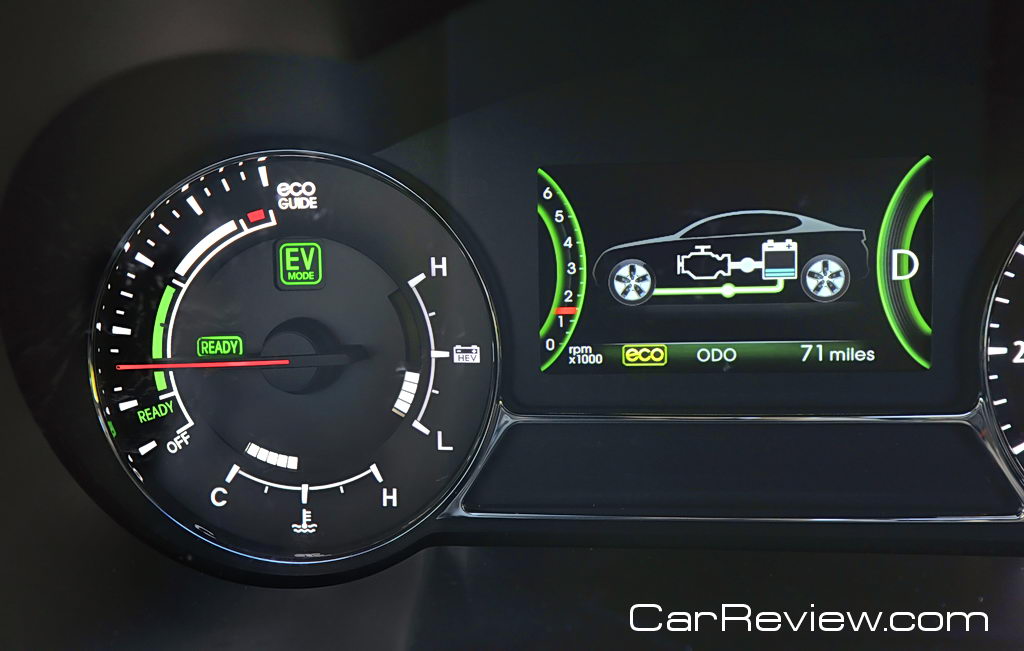
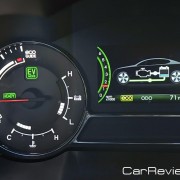
Kia Optima Hybrid active eco system display
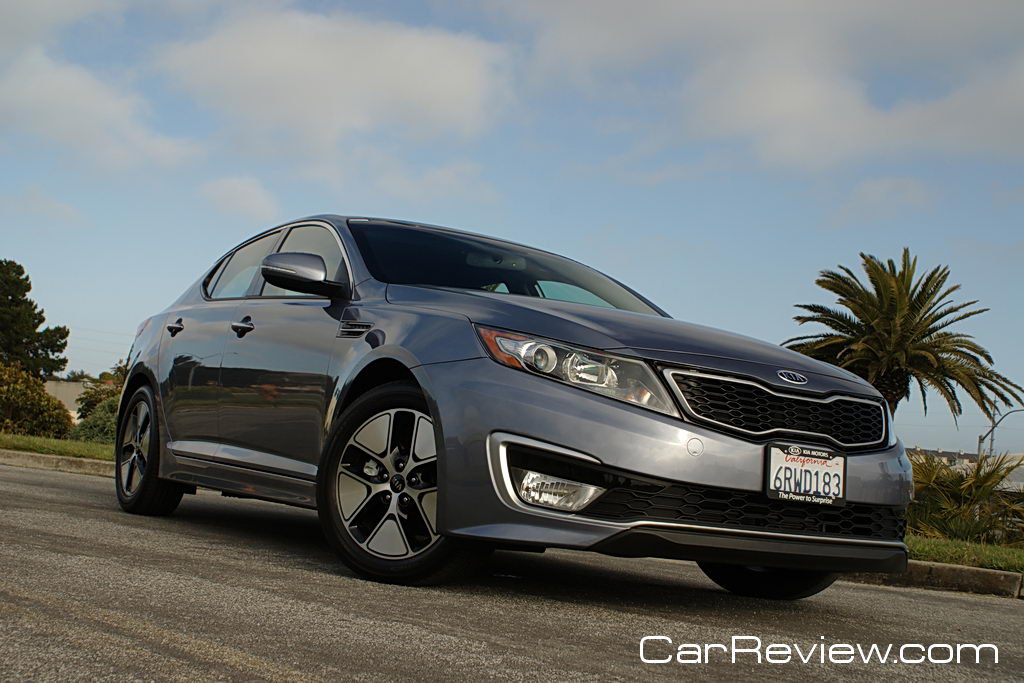
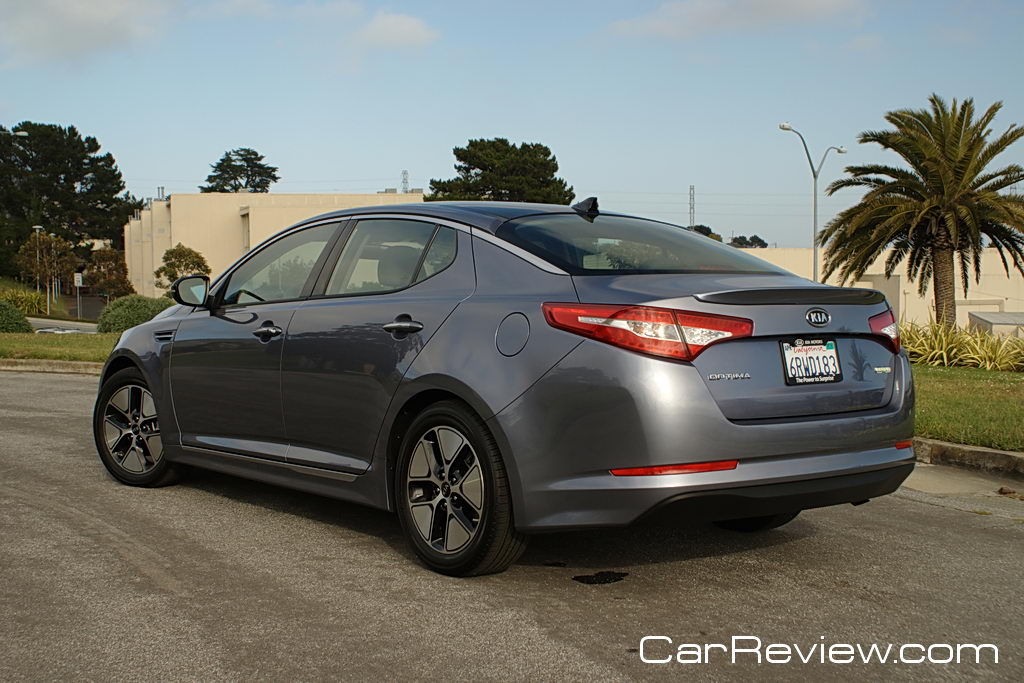
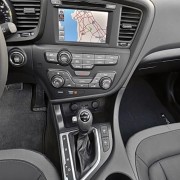
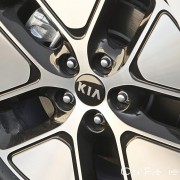
We recently had the chance to take the Optima Hybrid for a brief test drive around the streets of South San Francisco. On the outside, the car shares the same eye-catching exterior as the gas-powered Optima, save for a few hybrid badges and what look to be unique alloy wheels. The cabin also features the same roomy, well-built interior, and includes options like heated and cooled leather seats and a panoramic sunroof, amenities that used to be available only on luxury cars.
The Optima Hybrid features the same powertrain as its sister car, the Hyundai Sonata Hybrid. Combining a 2.4L 4-cylinder gas engine with a 40 hp electric motor and a lithium polymer battery, the system produces 206 hp. Rather than using a CVT (continuously variable transmission), the Optima Hybrid routes its power through a conventional 6-speed automatic transmission.


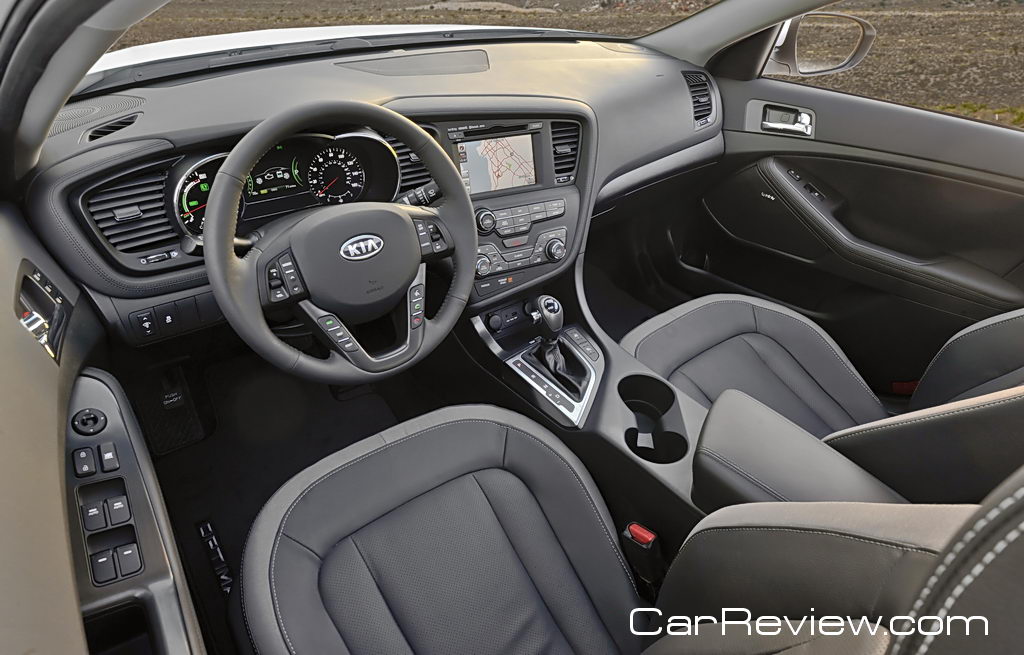
2011 Kia Optima Hybrid interior
Altogether, the system works well and you can barely hear the motor turn on and off when cruising slowly. Only at full throttle does the engine sound a bit raspy and unrefined. Acceleration is decent, although a bit slower than we would expect for a car with over 200 horsepower. Ride quality and handling are quite good, although the car does feel a bit heavy on its feet and the brake pedal could use some firming up.
Our brief test didn’t allow for a thorough evaluation of the car’s fuel efficiency, but the EPA rates the Optima Hybrid at 35 mpg city and 40 mpg highway, figures that compare well with competitors like the Ford Fusion Hybrid and Toyota Camry Hybrid. At slower speeds the car switches over to EV, or electric-only operation quite regularly, and you can coast on electric power at speeds up to 60 mph. There is also an Eco mode, which changes the throttle response to encourage more frugal driving.
2011 Kia Optima Hybrid 


The Optima Hybrid starts at $27,250 and comes quite well equipped. Our loaded tester stickered at over $30k, but featured enough luxury options to justify the price. Like most Kia models, the Optima Hybrid should compare well on value with other hybrid mid-size sedans, and its more aggressive appearance might even convince a few car enthusiasts to take a hybrid for a spin.
Source : Carreview.com